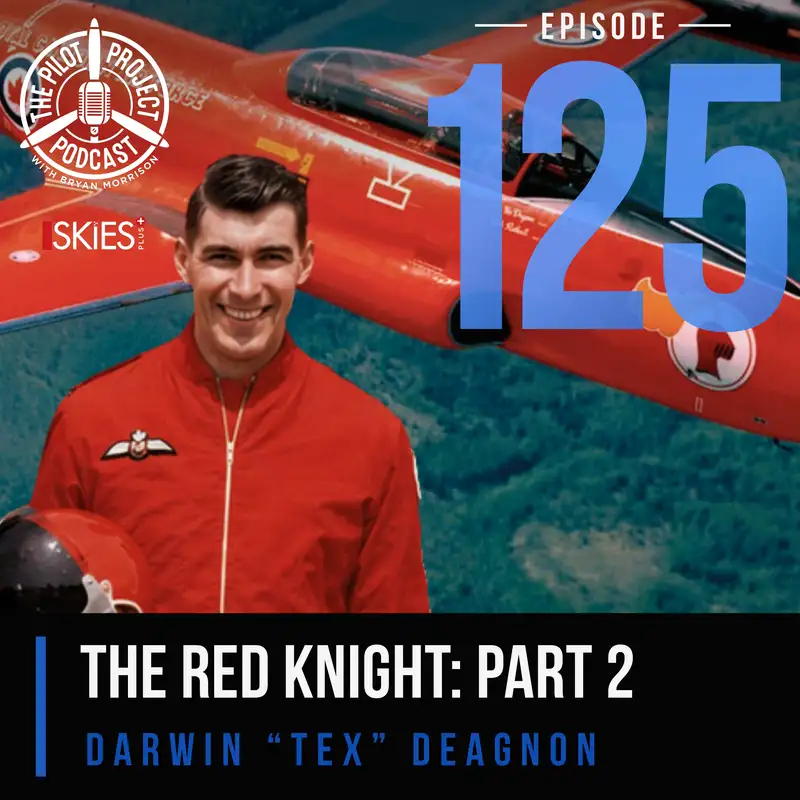
Fighters: The Red Knight Part 2: A Lifetime in the Cockpit – Darwin “Tex” Deagnon
Hey, everybody. It's your host, Brian Morrison. Before we begin today's episode, we'd like to take a moment to remember someone who helped make it happen. Harry Tenkate first reached out to me about four years ago asking if I had ever listened to the shepherd on Christmas Eve, which the CBC radio show as it happens plays every year as tradition. Almost exactly a year ago, Harry reached out asking if I had ever heard of Tex, the guest of this and the previous episode.
Bryan:He told me about his career and encouraged me to reach out. Over the course of the next year, I found out that Harry was a pilot and had also been a producer for CBC. He also created the Thermal Podcast, which was a podcast focused on one of his great passions, gliding. I last heard from Harry about a month ago in October when he offered to help with the recording process with texts, so it came as quite a shock when I saw his obituary posted by his wife. Harry had never mentioned that he was sick with cancer, which seems to fit the pattern of our short correspondence of selflessness and generosity.
Bryan:While I didn't know Harry well, I always enjoyed hearing from him. Rest in peace, Harry. Blue Skies.
Advertisement:This podcast is presented by Skies Magazine. If you're interested in the Canadian aviation industry, Skies is your go to multimedia resource for the latest news, in-depth features, stunning photography, video coverage. Whether you're an aviation professional or enthusiast, Sky's is dedicated to keeping you informed and bringing your passion for aviation to life. Visit skysmag.com to learn more and subscribe to stay updated on all things Canadian aviation.
Bryan:Fuel and ignition switches. On. RPM switches. Set. PD switches.
Bryan:Normal. Doors and hatches. Closed. Laydowns. Stroblade.
Bryan:On. Research check-in. Complete with your left. Engineer. Start number two.
Bryan:Starting to. Wing 31010, Pilot Project Podcast, clear takeoff, Runway 31 left. Alright. We're ready departure here at the Pilot Project Podcast, the best source for stories and advice from RCAF and Mission Aviation Pilots brought to you by Skies Magazine. I'm your host, Brian Morrison, and with me again for part two of our chat is former RCAF Red Knight, Darwin Tex Dignan.
Bryan:Tex, welcome back to the show. It's great to see you again. Thanks for being here.
Tex:Thank you. Glad to be here.
Bryan:Listeners can check out part one where Tex took us from his childhood on a Saskatchewan farm through pilot training, flying the f 86 Sabre with four thirty squadron in Cold War Europe, and his experiences representing the RCAF as the Red Knight in 1965. Today, we're going to explore his time on a t 38 Talon, including an emergency landing, his work training and evaluating military pilots, and his transition into a civilian aviation career that eventually included nearly eight thousand hours on the Airbus. We'll also talk about his return to the cockpit of a Harvard he had flown as a young student pilot and reflect on the people, experiences, and lessons that have stayed with him across nearly seven decades in aviation. So let's skip right to the t 38. When we last finished, we were talking about your time as a red knight.
Bryan:How did you end up going down to Tyndall Air Force Base in 1968 and 1969? That was for the Pilot Instructor School. How did that experience come about?
Tex:Well, I I was ready for a posting, and, I was trying to get back to the fighter program. And it was quite obvious, that they weren't gonna send me that direction. So, they sent me down to Tyndall Air Force Base, which I was quite happy to do him because that's another experience. And, try the t 38 was a very good experience. It's a, you know, high speed airplane and was like a t 33.
Tex:T 33 is old technology sort of thing. So we're going on to new technology, speed airplane, capable of supersonic at any time, two engines, I was only single engine pilot at that time. So, yes, it was gonna be good to me. So I was quite happy to go that route if that's where they wanted me to go. Yes.
Bryan:I mean, the t 38 is a beautiful aircraft. It's basically, I believe, an f five freedom fighter, but it has an afterburner and I think a few other small differences. But they're almost the same aircraft, right?
Tex:It's basically the same aircraft. Of course, two seater. You didn't have the leading edge slaps and stuff like that. So for example, our final turns and landing spaces were much higher than the than the f five type thing. And, my experience, going to the same, of course, what we were supposed to do is to train pilots to become instructors.
Tex:So you did a lot of listening and the guy did a lot of talk, tried to teach you various things and then you corrected him in his technique or his ability to do this. I dealt with people that were coming back from Vietnam. It was the height of the war, so I'd say 90% of the people of the students that I have were coming back from Vietnam. Wow. And again, it was very obvious that they were very glad to get out of that situation because they did a lot of clear share support with the army in Vietnam and did things of that nature there, and did a lot of close combat type thing.
Tex:When they did strafing down there, they were actually strafing live people and things of that nature there. So these people were very happy to get out of that environment. Was one of the first things I noticed that they were just... They weren't the normal military guys sort of thing, calm, cool, collected sort of thing. They were just very excited to get away from the from the combat type of situation.
Bryan:Did you find that those young folks who had been over in Vietnam, you know, you said they were excited to not be in that situation. Did you find that many of them had been deeply affected by that combat?
Tex:Some some were more affected than others. It depends exactly what they did. Once it did close ground support, for example, strafing troops on the enemy troops and dropping bombs on the enemy at close support with... They were more... You can see they were more emotionally involved because, you know, it's...
Tex:I guess it's the old thing, thou shalt not kill, and they were out there killing people. For sure. And now the guys that did high level bombings were a thing, doing strafing over Hanoi, they just dropped the bombs and had probably never seen where they dropped the bombs and then came back and landed back in Thailand or wherever they were out of that particular time. So two different things. Yeah.
Tex:You could see that the emotions were different. You know, their emotions were different. Yeah.
Bryan:Yeah. And, you know, you talk about that thou shalt not kill. I mean, there's a whole book on that. Right? I believe it's called On Killing Yeah.
Bryan:Where they talk about the psychology of it and how we are just we're programmed. Like, it's funny because people think, you know, war is a massive part of our history and for sure the human race is a violent species, but at the same time, the average person does not wanna go up and kill somebody.
Tex:Yeah. And the thing that was very noticeable, like I mentioned about, growing up in a in a return soldiers type environment, they didn't wanna talk about it. And the same thing, these guys were not free to talk about these things. They would always change topic or talk about something else because they didn't wanna talk about those experiences.
Bryan:Yeah. I mean, I think that it's only very recently that the culture has changed a bit towards sharing your experiences and maybe even going towards some healing through kind of talking it out. I think for a long time, including in that time period, the the common wisdom was basically bottle it up and try to move on with your life. Yep. Yeah.
Bryan:As we said, you were moving on to the t 38. You've talked about a bit of the differences, but what was it like to get behind the, stick on that thing and how did the t 38 compare to the saber? You've talked a bit like, obviously, it's better than the t 33. How did it compare to the saber?
Tex:Well, it was more responsive and control wise. And of course, he had a lot more power to play with. He felt it's a different experience. So going from old technology to it from a T33 or from a Ford 1928 to a 1960 Ford nowadays, it's a total different experience again. And it was more responsive, more active.
Tex:However, we come to aerobatics and things like that, it was a little bit different because definitely could do a loop within 2,500 feet, whereas a loop there, because of the speed, it'd be 5,000 feet. So you couldn't do a show in front of a crowd with a t 38 like you could with a t 33 if that's what your job was. And, so that was a comparative difference there. But it was good to fly. It's a new experience and, going to the high speed world sort of thing.
Bryan:Yeah. That's kind of the funny thing when you go to air shows. Like, I love going to air shows and, you know, the fast fighter jets are so thrilling when they go by, like, with afterburners and it's so loud and that's such an experience. But when those big fast fighters, you know, they do their pass and then it's like, you know, half a minute before they're back because they've got this massive turn radius. That's what, you know, has made the tutors so incredible for the snowbirds, right, is they're able to fly slower and still be maneuverable and stable and safe so they can keep that show tight in front of the crowd.
Bryan:Yeah. Yeah. So while flying the t 38, you received a good show award after landing with the nose gear up. Can you walk us through that emergency? Maybe even just take us through the day, like how did that day start for you and and how did you end up back on the ground?
Tex:It was a normal, training exercise and, that particular one was something to do with emergency landing and things of that nature and lowering the gear. So the chap that was acting as instructor, he was sitting in the back seat of course, and he was telling me how to go through this. And he'd be talking all the time, and now we lower the gear and things of that nature there to go to procedure, okay? And when it comes out lowering the gear, the nose wouldn't come down. And of course then he stopped talking at that particular point because we only had the two main crew down.
Tex:I said, well, I said, go ahead and experience if you had to use emergency lowering type thing. So he goes to pull the control to release the up latch for the nose gear so the nose gear would drop down into position. It wouldn't drop down. So then I took control at that particular point and brought the gear up, we selected down again, still no nose wheel, I would select the emergency handle, was on the left hand side, I pulled it and the air handle come into my hand. So we were stuck with an airplane with two main gear down and no nose wheel.
Tex:So going back, then I took control, that was the end of the training mission sort of thing. I cut back and sort of declared my emergency situation and they cleared off. There was two runways there at Tyndall, I took the outside runway and with my experience, I requested foam down the middle of the runway so I could lower the nose into the foam for landing. So I come around, did my approach and touched down and lowered the nose into the foam. And at the very last minute, but I didn't let it bang on.
Tex:Then sure enough, we stopped in barely short distance and of course everybody came around. That particular thing, where I got the Good Show award, of course, I guess the procedures I followed and what I did, blurring the nose into full, which if Lordens was on the raw pavement, have ground the nose right off. And I did so minimal damage on the airplane, it it had to change the skin of the airplane. It was that damage, and it was back flying about three days or four days time. And so I guess that's why I got the good show award for going through these procedures.
Bryan:Wow. That's wild that that thing was flying that that quickly afterwards. Like, for for listeners, the idea that an aircraft that does a... Basically, a partial belly landing with a gear up, that it would be flying a couple days later is is crazy. Yeah.
Bryan:You mentioned this foam. What is that? I I haven't heard about this.
Tex:I'm not sure exactly what it is. It's it's, looks like about six inches of foam on the runway. What it's made out of, I have no bloody idea.
Bryan:Is it made specifically for like emergency landings and that kind of thing?
Tex:I guess so. I've seen gears before, for the same type of thing for our aircraft one time. Hanker was the left gear that was locked in position and, the T-thirty three, And of course, that tip tank on the left side came down, it could cause the airplane to spin a little bit, but he was in the foam, so there's just minimum damage. The same thing with me. By the time I actually stopped the airplane, there was no foam left on the runway because I asked for 2,000 feet of foam.
Tex:Yeah.
Bryan:So before you come in for the emergency landing, is there any kind of preparation? Like I remember when I was in Moose Jaw, we would talk about, okay, I'm gonna try to use g force to lower the gear. I'm gonna I'm gonna burn down fuel so there's not too much fuel in the tanks. Like, did you guys go through steps like that?
Tex:Well, the engineer came on the radio type thing, we talked about it a little bit and I said, I can't do anything more now. Said, it's the emergency handle. I said, we go up and down on the gear, it's not gonna come down. And I said, I have the emergency handle in the cockpit because the line broke. Actually, I just...
Bryan:Oh, I didn't catch that. The handle came off in your hand?
Tex:I pulled it so hard, I guess. At that particular point, I didn't understand the actual engineering buildup of how the gear was made on the house, but there's an over sector type hook and if the bearings were wore on that hook, it wouldn't allow it to go over the center, that's what... When they got the airplane on the ground, they brought it into this hangar sort of thing and set it up on jacks all around, and they tried to lower the gear again and everything else, and they got underneath there and checked why that gear was not releasing. It was the overhead latch that actually hooked on to the doors and gear that would allow to release type thing.
Bryan:Wow. Another consideration whenever you have an emergency and ejection seat aircraft is, hey, do we try to bring this home or do we eject? I'm gonna guess with a nose wheel, there's very little danger of catching an edge and cartwheeling and that kind of thing versus, say, if a main gear... One main gear only lowered or something. Was there any consideration of that?
Bryan:Or, you know, what situation would you... Would lead to an ejection?
Tex:No, I was not close to thinking about ejection. Nope, it's not never coming to the picture at all. And the big thing I guess was, I wanted to keep the airplane straight on the runway as best as possible. To me, putting some foam on the runway would help keep that airplane going that direction at a high speed because the T-thirty eight compared to the F-five or even to the T-thirty three, our approach speed was almost 40 knots higher. So we're very fast coming across the button of the runway.
Bryan:How fast about was the approach speed?
Tex:Oh gosh.
Bryan:Just ballpark.
Tex:Yeah. We do the final turn at about 200 and, so approach would be about one fifty to one sixty to cross the threshold. I would say one thirty, one forty. We're way up there sort of thing. That's much higher than even the airbus for God's sake.
Bryan:Yeah. To put that in perspective for listeners who aren't super familiar with judging what... You know, how fast is a knot, A 160 knots over the edge of the runway, which would be the speed he was approaching at, is almost 300 kilometers an hour. So they're they're coming in like screaming fast.
Tex:That was a big thing noticeable about going to a d 38 is that everything was started at a much higher speed. Yeah.
Bryan:Yeah. Yeah. Did you have any other memorable emergency experiences through your career?
Tex:No. We flew our buns off on the t 38 because we did two trips a day and every second weekend, you're a cross country type thing. You're you're away with the airplane an awful lot and they were constantly doing an instructed type job to get these people through. And so it was a very, very busy operation. Because of the engines, with the same engines that the F-five had, they were very delicate type engines.
Tex:So So I did a lot of single engine work even though I was flying a twin engine airplane. But that was sort of common knowledge because that engine they had, the J-eighty it was called a J-eighty five or something like that, was a very delicate engine. And after a while, the turbine blades would go over, there was always some little things that was going around with it. So for example, I landed one time at, I think it was in Texas, the NASA base down there at that particular time, I lost one engine and requested to go to San Antonio because that was a big training base, it had the airplanes there and everything else, so I'd last a little bit, five, ten minutes, flew a single engine to that base and be darned if I didn't lose that engine on landing, in which that time I had no hydraulics, everything froze up, I couldn't even taxi or I couldn't even turn the airplane, I just... Everything filled out, so I was on the runway sort of thing.
Tex:So it was just part of the part of the ballgame type thing, so.
Bryan:I suppose, hey, someone was looking out for you that day for that engine to to fail at that time and not not ten seconds earlier. That would have been an ejection.
Tex:Well, yeah. Of course. I would have to eject you. Yeah.
Bryan:Yeah. Yeah. And low level too.
Tex:Yeah. But, you know, things happened very quickly. I think we went from one base to the other base for probably about five, ten minutes at Saint Vincent. I didn't fly around for a long time at Saint Vincent.
Bryan:Yeah. I imagine, on an aircraft that's known for Yeah. Somewhat unreliable engines, being single engine is probably pretty uncomfortable.
Tex:But, you know, I I think all it did... They took their airplane off the runway. Matter of, half a day, they had two engines changed out back flying that quick. Yeah.
Bryan:Wow. So just quickly, before we move on to some of your leadership experiences, working at Tyndall there, you're teaching instructors. How did you find that compared to working in Canada?
Tex:Probably the right word was it was boring tense. Other words, we had to get the job done, like, right now. You don't fool around type thing. So you didn't waste any time doing other things. You concentrated very heavily on instructing.
Tex:The guy that was gonna become an instructor, he did all the talking basically. A moment till he left the ground until he got back down and gone, he never stopped never stopped instructing. He was telling me something to do about the airplane at all times. Whereas our assistant at home was a little bit more slower than that, because I did the same thing when I came back for a while, making instructors. And, the guy didn't do as much talking, but we covered things in a set pattern.
Tex:To do, forced landing type procedures, we do one trip on forced landing procedures, and that was it, and to go on to that sort of thing. Or stall procedures and the spin, that sort of stuff, when we do one or two trips in that route home. Yeah.
Bryan:Do you think that that sense of urgency in The States was because they were fighting a war at the time? Like, they just needed those pilots ready to go?
Tex:Well, see, initially, was supposed to go to Randall Air Force Base, which was, at that time, was where the school was to make instructors. But the war was so busy and they needed to make pilots, they turned that base around to undergraduate training schools. That was number 10. That's how many schools they had. Wow.
Tex:And they moved everything over to Tyndall. Tyndall was F-106s and 100 two's, which was to support NORAD at the time. So the base was mostly a NORAD type training base. And, we were just added to that base at Tyndall to do the instructor type school.
Bryan:Was part of the reason they were bringing in Canadians because they were using all their pilots operationally or was that pretty standard at the time to kind of share NATO instructors like we do today?
Tex:Yeah. A couple of courses we had, at Tyndall was to bring Canadians down there and and turn them into instructors, and they went back to the various bases. I can't remember, think there was about 50 pilots that came down to do the particular program. Just to become instructors at, at the various, under training bases. Yeah.
Bryan:Okay. Eventually, you moved up from instructing and went into some leadership positions within the air force. From 1970 to 1974, you worked in recruiting in Winnipeg before becoming commandant of the instrument check pilot school. Yeah. Before we jump into the instrument check pilot school, how was your time recruiting?
Bryan:I always have thought that a pilot in a recruiting office, as much as we're tight on pilots and and kinda need them flying, I get so many questions from doing this podcast from listeners who wanna join kids in high school, air cadets, even guys and gals in their twenties and thirties who are wondering about a new career. And so many of their questions I think, oh, man, this is really one for a pilot in a recruiting office. So did you find it was a useful spot?
Tex:Well, I got to learn the, the personnel side of things and, people were selected, stuff that nature. So initially I just did regular recruiting, and then I got into the actual selection process towards the end of the recruiting program. This is after the people wrote their tests and things of that nature there, and we'd decide, Okay, the best thing for you to go is to go to the trade side of things. And so we'd make that selection based on the tests and based on the interview, and based what he came to school with. Some guys came to recruiter, he only had grade eight or grade 10 education, had no education.
Tex:Then you get the yacht guy to come there who had a degree or was in university and wanted to get involved in the military programs. Or he wanted to become a doctor or something of that nature. So it was a good experience learning about people's personality and judging their actual academic ability or were they smart or were they stupid, you know, so to speak. And that was a good thing. So I realized how I got to in the program myself and become an officer, all that sort of thing.
Tex:So yeah, it was a it was a good experience.
Bryan:Yep. Okay. Next, you were at the Instrument Check Pilot School, as we said, as the commandant. What was the school's purpose and what were your responsibilities?
Tex:Well, see, how that came about, of course, I guess when I went up for a do... For a posting and then they said, well, where'd want to go? I said, well, I always wanted to go back to the fire program. No, wound up going back to the squadron at Winnipeg at that time, which had DC-3s or the military was called C-forty seven Dakota type aircraft. Didn't think that was very exciting.
Tex:But anyway, was going back flying. And next thing I want, of course, I was due for a promotion, guess. I got there. I did maybe a few of those basic flights. Next thing I up being up in one rank.
Tex:And to do that, the position was to take over the instrument checkbox, which I think was the way the personnel that did the post initial thing, they knew I was coming up for promotion, and that's where I was gonna wind up. And of course, was... I got there and I said, now that I've got promoted, I said, I'm going leave the aerobatic team. Nope, they already had a leader. Then I knew I was going to be promoted through that.
Tex:And the instrument check pilot school was a very good experience To do that, of course, I already was an instrument check pilot. So I think I happened... I was at Moose Jaw. I became an instrument check pilot, unit instrument check pilot, UICP. And then so for me to run the school, I had, what, six instructors, I think, guys worked for me.
Tex:I had a USF exchange officer. For a while, we had our guy from the RAF. There was an exchange officer that worked for me. And what we did is give people what we call... They got their ticket.
Tex:They got their instrument rating to fly. And the military was sort of separated from the civilian side of things. The civilian side of things, you had a little different procedure, But that sort of all changed out, sort of all more tied together. And also with being the school of commandant, I went around and checked the unit pilots all over rest of the air force. So I'd go I'd go to Europe and give the big guys their annual ticket every year.
Tex:I'd go to helicopter squadron. If the guys had tickets, I'd give them their ticket there as well. So it had to moving around quite a bit as well. Good experience. And we had the DC-three.
Tex:We had the two thirty three to fly. And we also had the Kiowa helicopter that would come over from Portage, because that's where the helicopter school was at that time, and have the helicopter there probably for every course it was about six weeks or about five days, we'd have the helicopter over there for the guys that came off a helicopter squadron to get it to really as a as a Czech pilot.
Bryan:So during your time as commandant, you mentioned that you organized a visit to the French Air Force's equivalent school. So what exactly is that, and how did that come about?
Tex:Well, we did that six week course. We'd spend a week someplace on the road, and, we do various things. We went with the United States Air Force, for example, or down the Air Force Base in Texas and went down there and checked them out. We did a tour with the RAF, England. And so one day we're sitting there just having a cup of coffee and shooting the crap and just say, hey, how about the French Air Force?
Tex:And so I put one guy in charge, think his name was Bob Stone, I think I remember his name was, and I said, Hey, organize this sort of thing. He did an excellent job and got us to go over there. So we organized the trip with our rail planes to get the four wing sort of thing and then for four wing, we've had vehicles all organized. And away we go to a base in France, which was the same thing as we had, as it turned out. Of course, we had a real problem with the language.
Tex:All those guys would speak English at the school there. And we used the type guy. He helped us out there, but we had a heck of a good time. And it turned out that they were doing the exact same thing as we were doing. So we had a proper reception type thing and a function, and missed dinner, so to speak, and and had good communication.
Tex:There was a couple of one guy that I talked to most of time, he could speak a bit of English. It was a good experience. It was a... And I organized that. And of course, as it turned out, I didn't probably go through the proper channels at the command to do this thing but we did it in our way.
Tex:And we said, well, you should have talked to me first and stuff like that but we didn't. We just did it our own way and it worked out just fine.
Bryan:Sometimes it's better to ask forgiveness than permission.
Tex:That's right. Yeah. After
Bryan:that, you ended up attending staff college in Toronto. You returned to Winnipeg to work in personnel intelligence. In 1980, you retired from the military at 40 years old. What led to that decision?
Tex:In that, that position I had had at Air Command was headquarters at that time, it was, first of all, research just to check people out that they qualified for the next job. And I learned a lot about judging people. Again, that really helped me out as far as am I able to look at a person and judge them very quickly. So it was a good job. In the meantime, of course, since I was a pilot type thing, lots of people in the command headquarters had to do some flying.
Tex:They just like get back checked out on the Dakota and fly these people around on weekends and after work and stuff like that. So I did a lot of flying in a staff job as well. So what led to that decision? Of course, I come up for a posting again, and I knew I was pretty close to another rank level. So I kind of insisted that I'd like to take over a fighter squadron because the F-eighteen was coming onto the stream at that time.
Tex:And so talking to the general Ocho, I had to fly around once in a while. He says, yeah, it sounds great. But he says, don't... He says, we're gonna send you back to Moose Jaw. And I could see myself winding up as a schooler at Moose Jaw.
Tex:And that wasn't appealing to me because I knew how things were gonna happen in the military then. I'd probably have one more flying tour and then I'd be in a staff position for the rest of my life. You know, I'd be back in Ottawa or someplace. That wasn't very appealing to me. So at that particular time, there was guys that left the military, like General Lett, people like that that was forming this Lear squadron or Lear outfit in Calgary, and I talked to them and they hired me right off the bat.
Tex:So I came back and told the general, he says, no, I'm gonna leave this earth. And he called me back into the office and says, you sure you wanna do this? And I said, yes, because see, I was good to stay in the service till 55 years of age or full retirement, or I could take full retirement at age 40. And so I said, no, I'm out. And of course, I went back to work in an outfit that was ex Air Force guys.
Tex:And matter of fact, Bill Fraser was there. He was ex-ray at night. Guy that was in charge of transport command, he was there. And General Lett, who is a very well known pilot in service and he owned one of the hangars. He's out of service at that time.
Tex:It was easy to work for them at all because he just said, they weren't gonna get me an f eighteen squadron. I was gonna wind up in Moose Jaw back instructing.
Bryan:Yeah. And the funny thing is listening to your story over these two conversations, your career is really one of... Other than, like, getting fighters and going to Europe. But after that, basically, it was kind of a bunch of postings that was not quite what you wanted. It seems like it ended up always being good.
Bryan:You always had a good time, and it was a good experience. Like, it's funny. Every time you finish talking about a job, you say, yeah. It was a really good experience, which is awesome. But, you know, after a long career of postings that weren't quite what you wanted, for them to finally be like, hey, also, you're not getting this one.
Bryan:I can understand why you said, you know what? It's time
Tex:to go. Well, another thing is, you know, if you get to know me, teaching people to to fly, I took great pride in that because... I guess I was good at it as it turned out. I was too good at judging their their personality, weak spikes, and dealing with them. I always treat everybody as positive first until you can prove to me that you have some real bad negative traits that are not suitable for what the job we're going put.
Tex:So I could judge people very quickly, I could check their weak points, work on their weak points, build on those things up. And it's going back to the old story, when you're in the squadron as a fighter pilot and you're leading a section of four airplanes, you're only as good as your weakest man. And so it's up to you to get that weakest man up to schedule or get rid of him, because you're not gonna do any good. That's kind of a rough term or post them. You Or haven't posted.
Tex:But, you're only as good as your weakest man in combat if he was a leader.
Bryan:You also did some work. This is pretty interesting. You flew in Canada's Arctic Regions flying c 47 cargo aircraft, which you said you had some experience flying within the air force as well. What was that operation like up there?
Tex:Well, well, we did it earlier, for example. We did a lot of, medevacs to the Arctic. And if we landed at a place like Resolute Bay or someplace like that there, and you had to take care of your aircraft in a special different way, you make sure it was heated up, even though it might be minus 40 outside like that, you only spent minimum time on the ground to pick that patient up and then get the heck out of town and get back home as quickly as possible. But if you had to spend any time on the ground, you have to make some arrangements to keep that air plaque warm a little bit. So that was big.
Tex:But the DC, I would call them DC-three because that's the last one, but the C-forty seven Dakota, for example, did quite a few trips to Churchill. Again, very, very cold. And again, you do the Orbital trips back and forth, but going up to the Arctic, have to do things like make sure the engines were covered, maybe take the batteries out and keep them warm, so you can at least charge the airplane again. But the big one was to keep the engine as warm as possible, cover with blankets, and if you can get some heat on them some way, that'd be the best thing. So that was a big thing, is taking care of your airplane in the cold environment was a big one.
Bryan:Yeah. That's always a challenge. Even taking the Aurora up to the Arctic regularly, you go up there, you fly like one patrol, and then the plane breaks for five days. The prop seals leak or something of that nature. It's definitely a challenge operating in the Arctic.
Tex:Yeah. Well, in the civilian world, when we for a short period of time there, when we had the DC-three, we got from the BC Hydro at that time, which was a DC-three. We'd go do trips to Anuvik and we wouldn't shut the airplane down. We would do hot filling to check the oil out sort of stuff and just keep the airplane running because we weren't sure if we were gonna start it after the dates are for a while. So we just kept the airplane, did hot charter runs.
Tex:Yep.
Bryan:You also spent four years flying for Ranger oil, operating everything from a Gulf Stream to to a De Havilland Beaver, which is, you know, an iconic Canadian aircraft. What kind of flying was the company doing that required such a diverse fleet?
Tex:Okay. Ranger Oil, that was very good experience. We were a drilling company and we did a lot of drilling in Alberta, mostly on gas wells and things of that nature there. Jack Pierce was he was in the military for a very short period of time. Of course, him and his brother, they bought oil wells that were shut down.
Tex:He got those oil wells going. And of course, he was an aviation type guy. So he had to have airplanes. And when I came to him, they had the Gulf Stream and our international office was in London. So we were in London at least one week of every month.
Tex:And we drilled in North Sea, of course, was big one. And we drilled in Africa and The Congo. We tried to drill down in Namibia. That was a good experience and it did one well in Pakistan. We tried to drill in China, I guess we couldn't make a deal with them in China, so we didn't go that route there.
Tex:And so, yeah, we were all over the place. And of course, he bought these extra airplanes. It was nice to have the Beaver. The Beaver initially had a different number. When the British had it, they called it something else and it was more of an observer type airplane.
Tex:It did work after the war in Germany. I'm not too sure exactly what it got, but the aircraft had a global on the top where the guy could observe and things like that. It was a different type of airplane. So the way he got it, we had to go back to De Havilland and it was turned into a beaver. So...
Tex:But it has had a lot of the old technology on it. Then the alaconda was just a play toy, just to go for... Well, Jack Pierce, he loved to fly the thing at night, so I did a bit of flying with him. But we'd go and shoot coyotes. He had 17 quarters of land there at Turner Valley in Alberta and we'd go out coyote hunting.
Tex:So we made the use of the clay toy, fly around his ranch and things of that nature there, and go fishing. We cooked the mountains with fishing all the time. And we took one of his kids up going hunting, sort of thing. We'd had the helicopter in the mountains, go around, check for a few sheep and stuff of that nature. We had another airplane for a short period of time, which was for the light transport people.
Tex:But the Beaver was good, I would take the Beaver up and we'd land beside the oil wells in the field because you could land just about any place. If you could catch your rig, I'd land the airplane there. Summertime, we had a cottage in I'd bring the airplane over to Kelowna, put it on floats, and we fly it around on floats. But then again, that was just for recreational thing. It wasn't to do with it, it was a job.
Bryan:Wow. So you had access to some pretty fun aircraft there, kind of... You had the professional side of things, and then you got to get in some recreational flying
Tex:Oh, yeah.
Bryan:Through the company as well. Yep. Wow. That's awesome. You know, something that was funny before the interview, you mentioned that you had flown a Bell helicopter during your time with Ranger Oil, just as you mentioned, but that you never considered yourself a helicopter pilot.
Bryan:Why is that?
Tex:Well, I I don't know. I guess it didn't seem like those guys had a good type job. And now, of course, helicopter up here in person with firefighting things, lot of pretty important type airplane. But it just I don't think it was exciting enough for me. I did a lot of training on it at Busheux.
Tex:We had a single engine two twelve or something like that. And we'd do a lot of flying in that. And we'd go out and I do all the practicing, know, go out in the farmer's field and use one to pick up a hay bale. We'd practice on putting one on a post and other type of post and keeping the aircraft nice and stable there. We did a lot of work.
Tex:Oh, somebody else did that type of work. It was just fun for me that day to go have a little fun, I guess, some flying.
Bryan:Yeah. You know, it's amazing looking at your career here. I'm just scrolling through things as we chat. And next, you went for five years in Fairmont, Hot Springs to help establish flight service, which is a whole experience unto itself. You ended up doing mountain flying as well.
Bryan:What kind of challenges did you find mountain flying had compared to flying in the Prairies or operating jets at altitude? You know, mountain flying has some pretty unique experiences.
Tex:Well, it depends upon type of airplane you have to fly with. If you're just a... Say, for example, a 185 or something like that, have to be very careful about downdrafts and things of that nature there. But one thing you did learn in the mountains is, first of all, you don't fly around at night. Okay?
Tex:Unless you have proper navigation type equipment. Nowadays, you've got GPS, so you can select yourself any place at any one time. You take helicopter guys that come in here, search and rescue, they have night vision, they can see at night. But normally, you just don't fool around with mountains. I had an experience.
Tex:One of my nephews, for example, thought he could fly from Calgary over to Kelowna and wound up smashing himself up against the mountain just outside of Banff. And you don't do these things. That's the first thing you learn, and you learn very, very carefully. And for example, was checking a person out, we had a 185 on float chair. He first came over here and went to this one guy wanted to get checked out and float fly.
Tex:So went to the mountains and the lakes sort of things, and I told him, you know, keep the airplane on this side because this is how the downdraft comes from this side, hits the water. And if you try to take off that thing, that downdraft is gonna push back into the water. If you go in the other side of the lake, that where the start to go... The wind goes, it starts to go up the hill, that's the part where you take off because it'll assist you to get off the lake quicker. So you learn all these things.
Tex:You could think about some of these things, what what happened. The last guy that crashed a helicopter up here, he did had no experience flying in the mountains very much, and sure enough, he was trying to set up with a little outfit up in the lake at high level. I'm sure he must have got caught in a bit of a downdraft and put his helicopter tail into the trees, and of course, that was the end of them, kill himself. But you learn about these things very quickly. And sort of a lot of them are just common sense type things, you know?
Bryan:And just for listeners, like mountain flying is literally, it might as well be an entirely different skill from flying. Like, it's so unforgiving, not just because of the terrain and the fact that, you know, there's massive altitudes to deal with and all that, but the shape of the terrain results in, like, extremely strong up and downdrafts that can completely... Like, the downdraft can be far stronger than you could possibly climb and you're going into the ground.
Tex:Yeah. Flying a small airplane, that's what you have to take into consideration. You know? You know, looking to the west here right now, up the river, there's cloud up there. And you don't you don't fly up that thing thinking that you're gonna go through that cloud where it is because the other side of that cloud, guess what, is rock.
Tex:Yeah. And you just take all the airplanes that have crashed around Hope, thinking that they can come from Vancouver area and come east bound, and they wind up getting them out at at Hope.
Bryan:Yeah. You know, even with proper equipment, I remember... I haven't done almost any mountain flying, but I did do some back on my wings course. And I remember distinctly, we're coupled up to a GPS approach, you know, as safe as you can be, and we're above the clouds and you can see the mountaintops poking up through them, and then you descend down into these clouds and you're just trusting that that magenta line is gonna keep you from hitting a rock wall. Yeah.
Bryan:Even with the proper equipment, that feels kinda scary. I can't imagine doing that without that.
Tex:Well, you take the glider pilots. Glider pilots is is big here in the valley. Now those guys know exactly where the downdrafts and updrafts are because that's what keeps them in air, so to speak. Being a glider pilot in the mountains is a good way to learn how to fly airplanes in the mountains.
Bryan:Something that's really cool talking about mountain flying is that you flew a Cheyenne two during the production of the film alive in the Purcell Mountains near the Delphine Glacier. For younger listeners, it's an incredible story about the Uruguay rugby team who crashed in the mountains and had to survive. Yeah. How did that opportunity come around and and what was your job?
Tex:Well, at that point of time, we're trying to set this flight service up here in Fairmont and this movie set came along. And of course, they wanted to be picked up back and forth from Vancouver so that took care of some of transportation of the team. And of course, when the movie Alive came out, they put this wreckage up on a Dauphin glacier to simulate where they were. And I guess one of the things in the movie, an aircraft did fly across it. And so they thought they were being rescued.
Tex:And we used a Cheyenne to just demonstrate that. And we waved the wings just a little bit. So we practiced that about, I think, three or four times to get it exactly right the way the film structure wanted to have the actual picture show. So it was very, very small. But I did more flying with those guys, flying them back and forth to Vancouver and stuff of that nature there.
Tex:It was a very small portion. And if you ever follow the film and you go through the whole program, they didn't even mention me, which I was... But I was the guy that flew the aircraft, they ever mentioned... I guess the airplane, a particular airplane at that time, thought it was maybe a King Air or something like that. So the proposed airplane, you get to Cheyenne to come from Saskatoon down here see her in few days.
Tex:Got sort of checked out so I could do that particular trip. Yeah.
Bryan:So you're in the film alive, but not credited.
Tex:Not recognized. Yeah.
Bryan:Yeah. You'll have to wait for those royalty checks to come in the mail. You joined Sky Services Airlines flying the Airbus a three twenty. What made you switch over to the dark side and just start flying for airlines? And then, of course, how different was the Airbus?
Bryan:Because you had been flying a lot of older aircraft. We're talking about De Havilland Beavers, c 40 sevens, things like that. Airbus is pretty widely recognized today as one of the most advanced airliners. What was that like?
Tex:Well, what happened here, of course, I couldn't make any money at this job with this service I was trying to set up here in Fairmont. And so, we ran over the things, to do and, lost the airplane because we couldn't pay for ferment anymore and things of that nature there. So And this so happened that at the same particular time, a bunch of the guys that knew there were ex military people, which I knew that some of them had left the service and gone to fly for private outfits. And I knew them very well, so I gave them a call and said, oh yeah, we're glad to have you. And so they're just setting it up and we did some...
Tex:I did some work for Sky Service when they were flying the corporate world. Like they used to fly the bank people around quite a bit and things of that nature there. I knew those people. So I got a job real quickly with them. And so sure enough, my house here at that time wasn't quite complete at that time.
Tex:I got rid of all my extra stuff and got somebody to rent the place out. And away, I was gone. And the next thing I was in Miami taking the course. And to me at that particular time was a switch from sort of actually flying airplanes and now learning how to manage an airplane, so to speak. Because the airplane was...
Tex:They had 150 some different computers on board that airplane. And they get checked out at Miami at the school there. It was a great experience and it's, Oh, this is different. But again, it was not necessarily really flying, having the controls and hitting up the valley sort of thing and going down and landing at Cranbrook and coming back and having a cup of coffee or something like that. So it was a different experience altogether, which I thought was really good.
Tex:I just thought I was really excited about going there. And I got onto the airplane really quickly. And I got up to my captain level really quick. And of course, what I wind up being? Training captain.
Tex:I was not training people.
Bryan:You can't escape it.
Tex:Some of the nice things about it, of course, I was... Became the base captain at Tea Site in England, and which was a a wartime base for the Canadians
Bryan:Oh, cool.
Tex:Back in the second world war. So it was very interesting. And once a year, we had we had had Remembrance Day, the squadrons would get together, there wasn't very number, and they would have a big mess dinner type thing and a dance and all sorts of stuff. Of course, I was invited to go to the... As being Acadian there, I was invited automatically to go to this sort of thing.
Tex:So I was back again in a memory state type thing with people that actually fought in a war or something like that, but we didn't talk about stuff like that. But it was interesting. The basis of where I got married in was the old officer's mess place, which was turned into sort of a kind of a bit of a hotel type thing, and talk about some of those old war stories with those guys. And, again, different people, they were just so happy to have a reunion with all these guys that actually survived the war type thing. That was their memories, I'm sure.
Tex:And that went out for a couple of years and of course, I think the last time there was only about 12 or 17 people that showed up, so they decided to disband that type of thing. But living there at that particular experience, all the little pubs up, where you'd find the old air force uniforms, hats, and pictures from the from the wars.
Bryan:Yeah. It really reminds you of that history of service. It's pretty cool that that place had Canadian roots as well for you to kind of connect with, especially as, at that point, a retired air force pilot. That's that's really cool.
Tex:Well, another interesting thing is when the war was over, when the final things were signed, any airplane that didn't fly was buried. Okay? They did pits for them and buried them. All uniforms and stuff like that in the supply store was all buried. Any airplane that was flyable, they flew back to Canada.
Tex:And they were just so glad to get away from the thing. So for example, the base itself on the one end of the tea site there, I guess there was a pit. We never went down to dig it up, but there was actually some Halifaxes and Lancaster aircraft buried there. I know they opened up a town centered in one of the stores. They'd taken their way to pick out the foundations for these buildings on the Alps, and they came across the Lancaster, buried.
Tex:They stopped construction, dug this airplane out, and the engines were there. I know they took it someplace, I guess, but that's what the area was like.
Bryan:Wow. At the end of the war, they were just so eager to put it behind them and go that they buried everything and left. Like, that's very... There's something about that that strikes a chord.
Tex:Yeah. And, again, it was a very, very busy job. Like, we had the Airbus three twenties, and we flew those airplanes eighteen hours, a little bit every day, except for one day. We only flew a twelve hour drive one day because we wanted to do a quick check on it and service up. And the Airbus, that period of time was there was service school all the time.
Tex:Any on serviceability was just minor type things, and you didn't stop me from flying. So we flew the crap out of those airplanes, you know, and that... That's how they made money.
Bryan:Yeah. You know, speaking of, you know, flying like crazy, you came back to Toronto, flew for another five years on the Airbus, which got you up to about eight thousand hours on the Airbus.
Tex:Yeah.
Bryan:From there, you kind of look back, you'd flown everything from the Sabre, the t 38, the c 47, corporate jets, Airbus, helicopters. What do you think was your favorite kind of flying and what was your favorite aircraft?
Tex:I think the aircraft that the most fun on was probably the f 86.
Bryan:Okay.
Tex:Yeah. You know, especially when I was a weapons instructor, I went back to the course. And they're like, on the f 86, like, you know, he could drop bombs, shoot guns, and all that sort of stuff. And, that was a real fire plane to fly.
Bryan:One thing I'd love to cover is you've had a lifetime of flying. It's obviously a passion of yours. You left the Airbus. You flew the Hawker 800 until January 2007. You eventually accrued more than twenty four thousand hours.
Bryan:How did you know it was time to retire?
Tex:Well, you see, Callum Hill was out there, flew a T33 for a short period of time. I got involved with them because my dad was a friend of McCollum and Hill was the other side of the family. McCollum's died out and just Hill left. So... And Hill, at that time, I had hired somebody else to fly for them.
Tex:And this guy heard that I was leaving the Airbus type situation. He said, do you want to come fly with us for a bit? At that time, Hill had progressed to the Hawker 800. And I said, sure. So next day, was in San Antonio, I took the course, everything else.
Tex:And I had to fly to Calgary, but I was living here in Fairmont. And so they communicate back and forth. And I was on one particular trip. I'm not too sure where we were in The States someplace. I was sitting there and I was saying to myself, like, what the hell am I doing this for?
Tex:You know, away from home, which I hated being away from home. So I came back and I said, thank you very much. I'm out of here. So I came back to Fairmont and retired. I just knew it was time.
Tex:Yeah. That was
Bryan:it. Yeah. But of course, you didn't fully retire. Right? Because beginning in 2020, you helped operate the volunteer run Fairmont Hot Springs Airport now.
Bryan:Yeah. Of course, that's volunteering. I think that's a great thing to do. What drew you back into that? What made you wanna get into airport operations?
Tex:There was a couple of things. First of all, I was familiar with Fairmount House Springs because I tried to sit in flight search. And, you know, it had... There was a meeting up at the resort, the lodge here, saying that the resort was going to stop managing the airport and pass it on to Government Valley Airport Society, TVS. So I went to those meetings, all sorts of stuff.
Tex:And I didn't realize at that particular time that the airport was built back in 1985. And the society was set up, I guess it was part of a tax write off, but the society and the resort are all in one, was the same people. And they wound up running the airport. And of course, the resort was sold and that changed over hands. And they said they didn't wanna do this anymore because the airport was costing the resort an awful lot of money to keep this thing going.
Tex:And they said, well, we're just stopping out to the society. So the society was gonna take over. And of course, there was no experience. They just dumped it over to the people that were local. And it didn't take me very long to realize, say, hey, there's nobody in experience with talking to Transport Canada, talking about airports and airlines, running an airport.
Tex:We just thought they were gonna do a job and take over and run an airport. So I realized that they were really short experience, and so I decided to get involved. And became a member of the society and then finally wound up being on the board of directors and that sort of stuff, and making our terms of reference to how we're gonna operate things in the basement there. But there was no experience there. And that's why I came involved.
Tex:And I wound up running the airport myself because I say we need this, we need that. We didn't have any money. We had to go to the local government and get some funds from them sort of thing. And we had to start charging fees for people to land here and stay overnight here, that sort of thing. And surprisingly enough, you know, being back before the people that used to own the place, the Wilder family, I used to fly them around all the time because they had an airplane of themselves.
Tex:Even though I was trying to run a... Open up a flight service here, I'd wind up flying them quite a lot. So I knew the people, knew the players, didn't realize how this airport was set up. And we wound up in a society with just the runway and the apron. And all the surrounding property, which was inside the fence, the thing to keep the animals off the airport, didn't belong to the society.
Tex:It didn't belong to the airport. We wound up with a very small thing here. So it was difficult and sometimes very frustrating, but I got involved in the entire part of... It was a voluntary type job, it wound up being a 70 a week job. I was here all the time.
Tex:That's why I kind of after five years said, that's enough of that because I'm getting away from my real private life, and I'm supposed to be retired. But again, another good experience and didn't do much flying. And we organized these year fly ins and things of that nature there. That one particular one, this guy showed up at the Harvard.
Bryan:That's great because it brings us right into what I wanted to talk about next, which was this Harvard. So I assume this is the guy who brought in Harvard three three four. Is that right?
Tex:Well, he gave me a call the day before and it's about time the the techs did not. I was known all over the place as being the airport manager here. And they... I did all kinds of phone calls. He gave me a call and he says, I'm coming to see my friend in Invermere, which is just to the north here, a small strip, mostly a Geiger type place, And I see my friend, he says, Do mind if I drop over there with the Harvard?
Tex:And can I do a bit of a show? I said, No, I couldn't arrange a show for him because that has to go through all the Transport Canada and that sort of stuff. I said, You're just too late to do something like that. I said, But you're more than welcome to come on over. Not really at the time, particular airplane.
Tex:And we're talking to him. He says, how he bought it, know where it came from. And it was up Moose Jaw and he says, you probably flown it. So I checked my logbook and sure enough there are, I think one of my third or fourth trips, I listed in this particular airplane. And so that progressed into the fact that said, well, you want to go up for a trip?
Tex:I said, hey, love to go up for a trip. So we arranged it. And of course, I was in charge of the flight at that time, and so I arranged everything so I'd go fly. And I went up and did over to the mountains here and did some turns and stuff like that and asked me to do a fair aerobatics. I said, oh, no, I just fly it around.
Tex:I like to do a low pass. And of course, I can't be in charge. I had the radios out and stuff, chased everybody away, did my low pass, did my show. And, I came back and hated the landing, of course, to get back in. That's how I got.
Bryan:Wow. And that was with Jim Hymak, right?
Tex:Yep. Yep. Yep.
Bryan:In September 2025 and you had last been in that aircraft, man, seventy years before that. Right?
Tex:I see.
Bryan:Sixty something years before that.
Tex:Yep. Yep.
Bryan:07/21/1958. So what was it like to climb back into that same aircraft after more than sixty seven years? Like, what was it like to hear the sounds and smell the smells?
Tex:Well, the first thing I read to me off the bat is, you you couldn't... You can't see forward on the ground, you know, because the things, the big engines there in front of you and you can't see forward. The other thing that got me off the bat is, god, these instruments are antiques. Did we actually fly with all these... Coming off the airbus, whatever, was magic.
Tex:And so that hit me off the bat. And then of course, the actual controls you have to... I guess if you're a pilot, it's like flying a bicycle or driving a bicycle, you never forget how to ride a bicycle. So you never forget how to fly an airplane. So was fun that respect.
Tex:Response was slow, God. Only had to take a look at speed. It's not actually there. You just put... You pull up, you lose your speed real quick.
Tex:So it's no different that way. And it was... They all began. It was all part of my experience, and it was a good thing. And I'm glad I did it.
Tex:I got a volunteer. I come back and bought up... I bought some gas for him.
Bryan:That must have been pretty special.
Tex:Well, he wanted to come again in this year. I couldn't arrange it again. I wound up... Even though I retired from the position as airport manager last year, they asked me to come back this year to set up things for client this year. So I came back and acted again as airport manager for one day and did all the work with transport counter to arrange the aerobatic display and things of that nature there, safety people, fire hall and RCMP and things of that nature there to set everything up properly.
Tex:So I think because the wife is still quite involved, the wife is involved with the fly and it's off, so I do back her up on a few areas that she needs some help once in while. I guess I'm not gonna get away from it completely.
Bryan:Do you think you'll end up, going up again in Harvard ever?
Tex:No, I don't think so. I think that was good enough. Why would I do it again?
Bryan:I suppose so.
Tex:Yeah. Maybe some other airplanes, like, up at one fifty occasionally. A guy has a Seneca. He just got rid of that. So I flew with him occasionally just to fly around.
Tex:Went out one to crash up here, the Naji wanted to go and check the spot. So the guy that flew the 150, he wanted to go have a look at that brick area. So I jumped with him, helped him navigate to that spot. The big thing about the 150, first of we had to get to 10,000 feet, and it took us half a day to get to 10,000 feet. I didn't have the power.
Tex:But, we did. So I play around with it. And, look at it now. I probably won't go about anymore now. I just...
Tex:I don't see the necessity of going up right now.
Bryan:That's fair. I mean, you know, during your career, right, you flew 38 aircraft types and you accumulated more than 24,000 flight hours. So to put that into context for listeners, first of all, you will meet very few people with that much flying time, especially as time goes on and we spend more time in simulators. It's just an insane amount of time. That is literally one thousand days spent in the air.
Bryan:If you were to commute an hour each day to work every day for a normal Monday to Friday job, it would take you fifty years to spend as much time in your car as Tex has spent in airplanes?
Tex:I've met quite a few people with twenty seven hours of battery. Oh, wow. You know, I've met quite a few people that have that time. As far as number of airplanes are concerned, I gotta be careful how you do that. Know?
Tex:I flew the C45 quite a bit in the service. In the civilian life, when we had that one airplane for a while at Edmonton there, it was a B-eighteen. I've marked that down as two different airplanes as far as the number of airplanes I've qualified on. And, BJT, yes, is is different. They all...
Tex:The main kits are... They kept stocks, they've got different interior. You've got, dinner troll heaters for keeping that barrier warm, stuff like that. So it's just a different airplane. For sure.
Tex:As far as getting a thing up and down, it's just about the same. Engines were probably the same. The DC-three, now I've got the DC-three. I have to remember the DC-three as a C-forty seven, it had all kinds of modifications on it for the war. And when I was in that ICP school, there was a c 47 there.
Tex:It was good for high altitude. Okay? It had superchargers on the engines, and we only had two crews checked out. There was east notes for the... For VIP flight.
Tex:And they had oxygen, so it had everything else on board. Whereas the average c 47 didn't have that. Another c 47 there as well was a search and rescue airplane. And one time in my travels around at an old work time hangar north of Winnipeg, so in the farmer's field, and I asked the farmer, do you got in there? And he said, I don't know.
Tex:So we opened the door, walked inside. Lo and behold, there was a set of skis for a c 47 and chino bobbles. So... And we had one airplane to 9905 as number that still had the switch in the cockpit for JADO and had the fixtures on the outside of the airplane at the back to hook JADO bottles on. And we actually had a few JATO balls.
Tex:We did a couple of JATO takeoffs. You just don't do that nowadays. You know?
Bryan:That's amazing. I just gotta tell listeners JATO is jet assisted takeoff. It's literally like rockets that you attach to the aircraft. That's crazy.
Tex:Only only because I snooped around that one hangar and went back to Crown Assets and says, hey. Can we... He didn't even know what was there. Another time I was climbing back in the back of the hangar, there was an engine in a creek, all sorts of stuff. And it was just the back of the hangar and dust all.
Tex:I checked the thing out. It was a engine for a mess time. Oh. And and how it went on the back of the hangar, nobody knows. Dusted all off, soldered everything.
Bryan:Wow. We're getting ready to close this out. I'd like to talk a little bit about Remembrance Day. This episode will air on November 10, the day before Remembrance Day. As we approach that day, what do you hope younger Canadians understand about the people who have served and the aviators who have served their country?
Tex:Well, I think, again, the experience here at Fairmont House Springs are now... Like, people I live in, is retired except that one chap I told you about, from the Australian Army. He was in the Army, and he served in Vietnam. And so him and I talked. But there's other people, because at the Remembrance Day, at the Legion, there's still a few members at the Legion.
Tex:And it must well, you see in the local paper, so and so passed away, he was retired army type guy. And the region is quite active, but again, it's not retired people. Most of them are not even military people, just sort of a club. And we'll go to the emergency room here and talk to anybody asking me questions. Like my son here now is 24 years old.
Tex:And he says, well, I'll go to the Remembrance Day. But again, he doesn't talk to anybody else that's been in war. I'm his dad. I have not been in a war. I have no idea what it's like to be there.
Tex:And my experience talking to these people, it's obviously a very, very dramatic, traumatic thing for these people to be in a war, to see people die beside you or have to pull the gun and shoot the guy in front of you. It's a different experience. Being in the Air Force, of course, you don't see that guy. You know, and maybe you're going out, if you do these sort of things, I would expect I was going to kill somebody on the ground or kill somebody in the air. I think that was the job of the time.
Tex:And so going back to remember these people that served and associating with these people, it had to be a very, very dramatic thing in their lives, in fact, with their lives quite a lot. So you have to remember how this must affect those people. That's probably the best thing I could say.
Bryan:Mhmm. Yeah. I think that's so important, not just to remember the people... Of course, we remember the people who never came home, who made the ultimate sacrifice. We also need to remember the people who did come home and were never the same.
Tex:Yep. That... That's a big thing. Yeah.
Bryan:One thing I do wanna challenge you on a little bit though is, I wouldn't call you a peacetime pilot. Right? I mean, you were serving in Europe during the Cold War. And I think you need to give yourself some credit because, of course, yeah, you didn't see combat, but you were there where it could have broken out at any time taking the risk of flying in Cold War era jets to keep the Western world safe and to preserve our democracy. So I do believe that that is service worthy of recognition, and I think that that era of veterans deserve recognition for holding the line and and helping to keep things stable.
Bryan:How do you mark Remembrance Day after such a long career of service to Canada?
Tex:I remember it by people I've talked to, basically, or tried to talk to. I think back to my childhood life, living in a community, which was all retired army people. I think back to those and think about, for example, last night I was going through all the neighbors, and they take my step grandfather on my dad's side. He was in the Boer War. Oh, wow.
Tex:And of course, the only remembrance he had in the garage, beside the house, kept all his old guns. But they never talked about being there. He just served there sort of thing. And of course, we went back to Foundry and begged up all kinds of things about it, but it just was a thing that you broadcast for a bit. So you remember those people, how they must feel doing this type of work.
Tex:Had to be... Sometimes I just can't imagine it. Like, if I had to jump into it right now and I had to go out and kill somebody or in a combat, right now I just can't imagine myself doing it. So thinking back about these people that did it, that could be a very dramatic thing for them. So that's how I remember these people.
Tex:It must be it must be really tough. Yeah.
Bryan:I really think that they went through hell on earth both during combat and then having to live with that afterwards, especially in a time where talking about it was not really done.
Tex:Yeah. Yeah.
Bryan:So final question. I think we could safely say you've spent your lifetime in aviation. What advice would you give to a young Canadian who dreams of following in your footsteps?
Tex:Well, I think the first thing I'd ask him is, well, what do you expect out of flight? If you wanted to go to be a pilot, what do you actually expect? What's your ambition? Do you want to fly an airplane? Is that what you want to do?
Tex:Do you actually want to fly the airplane? Because in a modern day world, you don't actually fly the airplane. Yes, you fly your product, you're actually managing a particular piece of equipment. So if you want to flexibly fly, probably the guys that do the most flying, hands on flying, are helicopter pilots. They are.
Tex:You know, the guys up here that do the firefighting. Know, one time we had, like, trolling airplanes on the base here. And these guys were actually flying, you know, they had two trips a day or whatever they had to do, and the water bombing things. They're actually flying airplanes. They're actually doing something with an airplane.
Tex:You take the medevac guys that come in here on their King Air 350s. It's all GPOs now. The airplane does the approach. They do the takeoff, landing. Do more flying sort of things than the Airbus type guy does, but it's all magic stuff.
Tex:I think the first Korean, I have to ask them, do you understand what, if you want to fly, what you're going to actually do? And I think that's a big thing. Whereas before, when I went to fly, oh, yeah, you're to fly? Yeah, that's what we did. We flew airplanes.
Tex:Right now, yeah, you might get your check out, ground school, and do your number of hours to get your reading and all sorts of stuff on a one eighty five or one seventy two. And if you want still want to fly, maybe you should be an instructor on that big airplane, then you will do a lot of flying. But if you want to move up in the world, next big step is maybe if you come out of Bush Pilot, you know, go fly for Buffalo Joe out of Yellowknife, and, they do a lot of hands on flying. But if you want to go to airlines and talk to the guys that come through here, the who has one of Harpets, the guy that does the aerobatics, They fly there on the Dreamliner or wherever they are. You know, they take off.
Tex:Yes. They do take off, press the button. The airplane does the whole flight until you do an approach. And you don't even have to do the landing because the airplane will land for you if you want, and you have to taxi back in. So you're not flying.
Tex:You're taxiing airplane around. Taxiing it for takeoff, taxiing it back in to park at the terminal. If that's the type of flying you wanna do, that's fine. That's what flying is called out is. A lot of pilots go that way.
Tex:That's where you wanna go. So you have to make sure that this is where you wanna go. You wanna quit halfway through it because you all of a sudden you realize you're not flying.
Bryan:Yeah. One thing I'd wonder is, in your opinion, you were talking about how basically, like, you end up in the airlines, you're essentially a systems manager. You think there's more chance for hands and feet flying if you go the air force route?
Tex:Yeah. I think you've got to learn how to fly airplanes, go the air force route now. Because you've good airplanes to fly. You've got good transport type airplanes to fly. You go to helicopter route if you wish, or you can wind up on the F-thirty five.
Tex:Apparently, got some F-thirty five though. But again, it's not a fighter airplane like the F-eighty six. Again, it's a total different type platform.
Bryan:The nice thing in the Air Force is even if you're flying a transport aircraft, say you're flying a Herc or basically anything but the Airbus, although I can't say for sure they don't do this stuff too, they are still... Like, the Hercules, the c 17, like, they're still gonna go do low level flying, cranking and banking through low level routes and stuff. Same with the Aurora, you know, we're at 300 feet 60 degrees bank. Obviously, that's nothing to a fighter guy, but for a big multi engine plane, like, you can still throw those things around. Right?
Bryan:Like, you're not gonna see that in the civilian world.
Tex:No. No. Not gonna see it. Most exciting route to go would be through the air force. Yep.
Tex:There's no stuff on top. Yeah.
Bryan:Well, Tex, that is gonna wrap up our chat for today. I just wanna thank you so much for sharing your story. It's been such a privilege to learn about your career. I mean, I don't think I've ever met anyone with a breadth of experience, aircraft types, hours and just the passion you have for aviation and the way you've pursued it through your life. It's been really, really cool to hear about that and I just want to thank you for joining us in this run up to Remembrance Day.
Bryan:I also want to encourage our listeners. Tomorrow is Remembrance Day. I want to encourage you to go to a Remembrance Day service, chat with a veteran, meet somebody who served, learn about what they've done for their country if they want to talk about it and just learn what the day is all about. So Tex, thank you so much for joining us. It's been a pleasure to get to know you and to share your story.
Tex:Oh, it's been a pleasure for me as well. I wanna thank you as well because going back in the last couple of days now, it's all I've been thinking about is is this and that's been good. And, for me, it's just to highlight a few points in my life, so it's it's good. It's fantastic.
Bryan:Okay. That wraps up part two of our chat with RCAF Cold War fighter pilot and Red Knight,. Tomorrow is Remembrance Day, and we just want to encourage you all again to get out to a service. To our listeners who have served. We want to thank you for your service.
Bryan:Also, we know that this time of year can be difficult for many of us. If you feel you need someone to talk to, we always encourage you to reach out to SIFMAP. That's the Canadian Forces Member Assistance Program. You can find the details by googling CFMAP, and it's on the canada.ca website. You can reach them at 1802687708.
Bryan:It is free and confidential. I have used it myself. So again, to our veterans, thank you for your service and be safe. Tune in next week as we sit back down with Andrew Hasno Faith to continue with part three of his series as we talk about Maple Flag and his journey back to Moose Jaw to become an instructor and working his way up to chief flight instructor at two Canadian Forces Flying Training School. We will get into the Euro NATO joint jet pilot training down in Texas and talk all about the fighter lead in training or FLIT that he was a part of.
Bryan:Do you have any questions or comments about anything you've heard in this show? Would you or someone you know make a great guest, or do you have a great idea for a show? You can reach out to us at The Pilot ProjectPodcast@Gmail.com or on all social media at at pod pilot project. And be sure to check out that social media for lots of great videos of our RCAF and mission aviation aircraft. As always, we'd like to thank you for tuning in and ask for your help with the big three.
Bryan:That's like and follow us on social media, share with your friends, and follow and rate us five stars wherever you get your podcasts. That's all for now. Thanks for listening. Keep the blue side up. See you.
Bryan:Engineer, shut down all four. Shutting down all four engines.