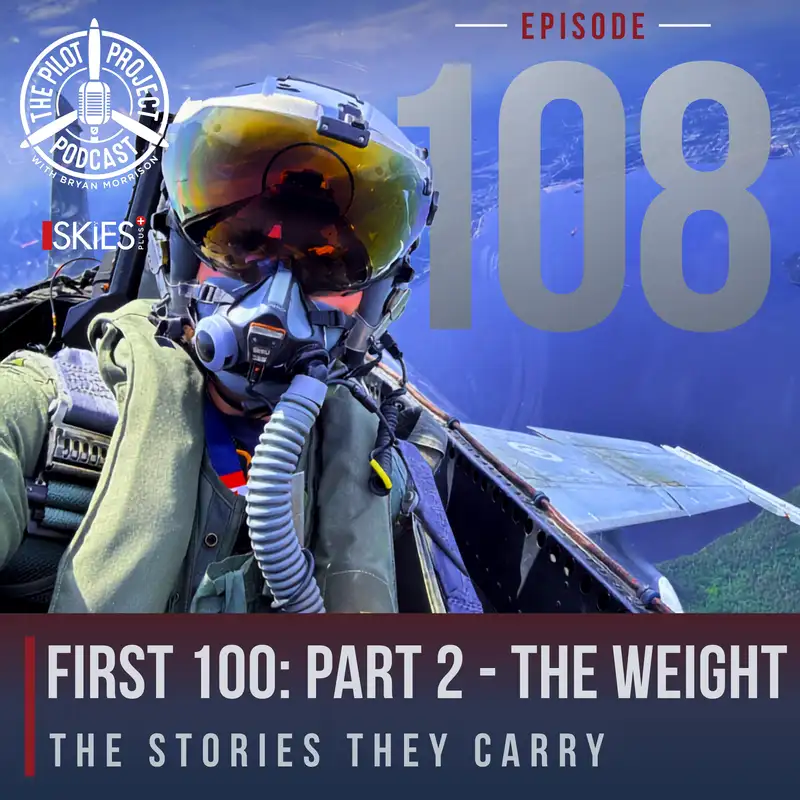
Logbook: First 100 Part 2: The Weight - The Stories They Carry
This podcast is presented by Skies Magazine. If you're interested in the Canadian aviation industry, Skies is your go to multimedia resource for the latest news, in-depth features, stunning photography, and insightful video coverage. Whether you're an aviation professional or enthusiast, Sky's is dedicated to keeping you informed and bringing your passion for aviation to life. Visit skysmag.com to learn more and subscribe to stay updated on all things Canadian aviation.
Bryan:Alright. We're ready for departure here at the Pilot Project Podcast, the best source for stories and advice from RCAF and Mission Aviation Pilots brought to you by Sky's Magazine. I'm your host, Brian Morrison, and I'd like to welcome you back to the Pilot Project First 100. If you missed part one, the climb, we explored the journey of becoming a military aviator from the first spark of inspiration through the challenges of training and the sacrifices required to earn a set of wings. Today, we continue that story.
Bryan:Throughout this episode, you'll hear stories from combat operations, search and rescue missions, humanitarian deployments, and high stakes emergencies where years of training are put to the test. Now before we begin, I should mention that this episode contains stories of death, grief, and trauma. Some of these stories may be difficult to hear, but they are only part of the story. You'll also hear how these aviators found the strength to recover, honor those they lost, and continue serving with those memories beside them. It's an important story to tell, and we are so grateful they were willing to share it.
Greg:I was a brand new FO. I just learned how to fly.
Eric:An s a five missile which exploded in between us.
Anthony:You know, we're shooting with our 50 given that Shulan Hill,
Dan M:you know, almost snapped the tail off the aircraft and killed everybody on board.
Greg:We had been shot. This is what we signed up for. Let's go.
Niels:You just don't know which way is up.
Dan M:He looked less than 25 or 30 feet above ground. Was that shot at me? Was that shot at someone else?
Bob:Only of you is gonna die.
Greg:Yeah. They were blown up real bad.
Vic:That was when I found out it was my buddy.
Anthony:If you ever smell blood, never forget it.
Dan M:He had an air to air collision.
Rich:Jen yelled the word bird.
Mike:I asked him how much time he had left in his tour, he said three weeks.
Rich:Jen was a force to be reckoned with.
Greg:When I got back from Afghanistan, I was so excited. That lasted for about three months.
Bryan:I'm not okay. I'm not okay.
Paul:You can't save everybody.
Lyndsay:Nothing could have prepared me for that experience.
Niels:Life is continuing even though I'm out on the boat.
Rich:Holy crap. Your life has just changed forever.
Bryan:This is The Pilot Project. First 100, part two, the wait. For every military pilot, there comes a day when the classroom is behind them, the instructor steps out of the aircraft for the last time, and the next flight isn't another lesson. It's the real thing. The stakes are instantly higher.
Bryan:Whether it's arriving in a combat zone, launching on a first search and rescue mission, or stepping into a flight line halfway around the world, every operational pilot remembers the moment they realized they weren't training anymore. The military has a word for when you first engage with the enemy. This is contact.
Greg:So when I left helicopter school and got posted to four zero three squadron, I started my course right away. That's when Canada decided to buy six Chinook helicopters and deploy eight Griffins to theaters. So it's funny because when you're going through pilot training, like when I was going through, we didn't have any deployed air assets other than, transport missions in theater at the time, and there was no visibility that that was gonna happen. And then all of a sudden, we bought six Chinooks and put a Griffins into Afghanistan, which was a very active combat zone. On my Griffin course, I was told by my CO at the time that I was gonna go, and and I was really excited about it.
Greg:You know, I was I was a brand new FO. I just learned how to fly, and then I learned how to employ the Griffin tactically, low level flying. And then we had to step that up a level and say, let's do it at 50 degrees, and let's do it at 3,000 feet, and let's do it with dust, and now let's do it with somebody shooting at you. We had to prepare for all that stuff. Our mission for CHFA was to protect ground troops.
Greg:And to do that, eighty percent of the casualties at the time were due to roadside bombs. So flying people by air was the safest way to do it. And Canada basically bought these Chinooks to put them there so that we wouldn't have to rely on partner nations to move our own troops. In order to put the Chinook there and keep it safe, it needed an armed escort, which we decided to put the BriF in there in that role. So anywhere a Chinook goes, it has protection with it.
Greg:Probably about 70% of our workload was Chinook escort, But we would also go out at night and look for roadside bombs. The really cool thing about the camera that we had, the way that Afghanistan was is in the day, it would be like 50 degrees. So everything would warm up. All the ground would heat right up. And then at night, it would get down to sometimes, like, minus 15.
Greg:So it's a huge temperature swing. And at night, you know, the Taliban would go out and dig these roadside bombs into the roads, letting all that cool air into that top layer of dirt. So we would fly down the road, and we'd see these things called lollipops, which was the main charge in the center of the road. And then they would dig a line, like a detonation cord kind of thing, so you'd have, like, a lollipop. For us, it would show up in the camera, and we would see that's a bomb.
Greg:So we would get an EOD team out in the morning, and they would detonate the bomb, and it would save lives. And then sometimes we would find people digging in the road as well, which we had certain rules of engagement that we would follow to deal with those threats, and that sort of carries over into the attack work that we would do. So our attack work was if anybody was in theater in the area that we were in, like, basically, we we mostly operated just in Canada's area of operations, but any troops that came into contact could call us up if we were flying in the area, whether we would be on Chinook escort or just as a two ship of Griffins flying around, and they would call us to support the firefight. Most of the time, we would show up and the firefight would be done because the enemy were scared of us because of the gun. The gun really was effective.
Greg:The friendlies were very good at handling their own firefights a lot of the time, you know, but I don't know any Griffin crew that was out there for very long in a firefight. The firefights ended pretty quick. When they're shooting back at you, it's I never had a problem with it, and I will say this, there's a dissociation that I'm able to have as a pilot because I didn't have a finger on a trigger. So and I think that the door gunners, they were the ones actually pulling the triggers, and now the aircraft commander has to talk on the door gunner. And then the door gunner, I like to think of it this way anyways, it'd be interesting to to get their take.
Greg:But they're not deciding what to engage. They're just following the orders, which I think gives a little bit of a healthy dissociation with it. Okay. Everything's been defined and stuff, and I just have to pull the trigger. And for a pilot, we just had to fly them and put them in a position to be able to engage the target.
Eric:The Kosovo conflict kicked off and was my first combat experience. And when I mean combat, it was combat. The very first night I was put on ground alert for closer support to myself and other individual sleeping by our jets, loaded, ready to go. We never got a call. Thank goodness.
Eric:Cause I didn't sleep that whole night. I was wide awake watching what was going on, but the very first Canadian force ship that went up, watched a Dutch F 16 shoot down, Serbian MiG 29 surface air missiles being fired at us, triple A being fired at us, flying night with very little training, trying to do a four ship formation using lights that are turned down without night vision goggles, using a radar where you could, super challenging. The triple A, you see it in the movies, holy smokes, when you're flying, even if you're at 22, 24,000 feet and the triple A only goes to 18,000 feet, It felt like the triple a was going way above me. The total flight time was typically about five hours. If you did a longer, mission, some people did eight hour missions.
Eric:It's a long time. And for about an hour of that, it's super exciting and nerve racking. And the rest of the time is this transit. The nerve racking part is air refueling, especially when there's thunderstorms around. They had an active integrated air missile defense system.
Eric:Some fighters were shot down, in particular US fighters that were shot down. You might recall a Nighthawk F one seventeen fighter got shot down and then some F sixteens as well got shot down with combat search and rescue. So we had combat search and rescue CSAR available ready to go in and pick up pilots. The one night we were flying as a force ship. I was number two.
Eric:We just passed our target. And as we're, going past it, number three, who was a couple miles behind us, called an SA five missile, which exploded in between us. So you can imagine that, you know, the hearts pumping and, we did not lose any Canadian aircraft or crew in that conflict. Pretty intense. As it went on, it became less so because we were able to suppress their defenses air to air and air to ground.
Eric:But in the early stages of that conflict, it was, quite intense.
Troy:Day one, did my unit check out. On day two, I got my feet wet. And on day three, the bottom fell out of her. A mission that was later the squadron mission of the year. It was for two gentlemen that had been thrown from their capsized fishing boat.
Troy:All the odds are stacked against us and against them. It was a foggy night, the winds were howling, rain was pouring, it was just not a very nice night. I was on a crew with a fellow named Jim that night. Jim was a very experienced pilot and thank God that he was. He knew what he was doing because I'll tell you, I was water skiing well behind the aircraft the whole night.
Troy:We went just above the rooftops down to the coastline. We got over the water, kinda assess what was going on down there. We saw the what the environment was throwing at us and, you know, the shoreline in that part of Newfoundland is not so much ashore. It's a it's a cliff. It's three to 500 foot cliff.
Troy:On the bottom of the cliff, you have some rugged, jagged rocks. We were searching the shoreline up and down the coast several times, we were not seeing these guys out there anywhere. At one point, we've got to back off and take a breather and see what the next course of action is going to be. So, we did that probably a quarter mile, I don't know, too far off the shoreline. Put the helicopter in a hover and just took a breath.
Troy:Okay. What are we gonna do next? We're discussing among the crew with the Sartex and the flight engineer. We're discussing with Coast Guard. Okay.
Troy:What can we do next? Where do we go from here? We're talking to JRCC. And at the same time, both of us, myself and the AC, Jim, we were MVGs and we saw a flicker, just a faint flicker of light. He said, did you see that?
Troy:I said, yeah, what was it? And then we saw another one and another one and it was coming from what looked like the bottom of the cliff right on the shoreline. Let's go take a look and see what it was and sure enough, this was one of the fellows that was thrown out of the boat. He made it to the shoreline and the reason we didn't see him before is because he was in the water struggling to get to the shoreline and we just didn't see him. So, yeah, we moved in, here was this guy, he had pulled his lighter out of his pocket, He was trying to light it.
Troy:The lighter wouldn't light, but the flint and the spark from the flint was enough for the night vision goggles to pick it up about a quarter mile offshore. So, where he was, it was on a very narrow ledge on the bottom of this, you know, 300 foot cliff and, we had to get him off the rocks. Again, this is where I'm very thankful that Jim was at the controls because yeah, he held it pretty steady, know, very uncomfortably close. I remember looking past him at the rock beside him and thinking, thank God Jim is flying this machine tonight, not me. And he was able to get the gentleman in the aircraft and he was hypothermic, alert enough to use his lighter to get our attention and that saved his life that night.
Troy:But it was that moment when we were what felt like just feet away from that cliff. This was my first major mission in search and rescue. And I remember thinking to myself, holy cow, what have I got myself into? Is this what search and rescue is gonna be?
Anthony:We were holding down seven days of a standby twenty four seven cast evac alert. Like, basically, we could get alerted anytime to go pick these guys up and get them out of a bad situation. You know, we end up taking off, man, right after the scramble. That moment right when I lay down, you know, scramble, scramble, scramble, run to the aircraft. We get overhead and the J Tech, what it was was there was 12 bad guys in the tree line.
Anthony:How's your job? We basically had to do about four gun patterns, you know, a racetrack type pattern, all four guns on the target and he had marked. Basically, got eight out of 12 guys that they gave us total there in, in, you know, in the end. And it was eight out of 12 on that tree line. And basically, you could see our guys shooting with our, like, you know, even our partner nation discos, you know, they're a level of, like, a 50 cal type thing.
Anthony:You know, we're shooting with our 50 cals, and they were just, you know, just giving that tree line hell, you know, just to to suppress to that point to where we could land. So we were lead, we land first, and, you know, we land on this narrow dirt road. I remember that little bit of a brownout condition where the dust comes up and all that. And they had put one American near the ox tanks and they started giving him a trick shot at me and another green beret beside me, then a partner nation guy who had a he got shot in the guts with what happened to him. We lifted off right and go right in back to the gun pattern and, you know, so we do a few gun patterns there, and we get to the point where like, okay, we gotta get this guy back, and we egress the area, we leave the area, and then we land, you know, I get more more bullets from my 50 cal, get more gas, what we call hot gas, which the rotors are turning and I'm, you know, putting gas back in the helicopter, And then we taped back off.
Anthony:They had one more guy to pick up. They picked him up and we did about multiple gun patterns on the same tree line. I started about half half or more of my rounds at that point. Basically, you gotta keep those guys heads down, man. Definitely a a moment that I never thought I would I never thought I'd be doing close air support with a rescue helicopter with a 50 cal, which is very,
Greg:very rare, you know, but
Anthony:it happened naturally on my first cast of bag ever.
Dan M:I was on the first crew. There were two planes and two crews since, and I was on the first batch to arrive in October 2014. None of us had, as far as I'm aware, maybe one or two on the two crews, had ever seen, you know, gunfire, especially at night. And so you have all these training sessions where you're talking about how to announce to the crew that you've you're under fire and what kind of your maneuvers might be to to deal with that. But first of all, we're air force assets, and we we haven't really seen that type of thing before.
Dan M:And so you'd see arcing tracer fire from various types of weaponry on the ground, And it looked like it was coming up on an angle and then coming back down. You're sitting there in confusion looking out the window. Like, was that shot at me? Was that shot at someone else? Is that just surface to surface fire?
Dan M:And, like, bullets normally do that. Does artillery do that? Can you have artillery tracers? And these are kind of, like, laughable questions if somebody's, like, aware of this stuff. But when you're just like a a baby pilot looking out the window at this stuff, you don't know.
Dan M:Like, you don't know what you're looking at. And so even if you are being shot at or if you're not, you might not necessarily recognize it correctly. It's it's easy to be confused and concerned. Like, I remember times, you know, getting surface to air fire reports and they some of them would be canceled later saying, oh, like, that was a flare, you know, because you're just seeing light at night, and you don't know if it's a threat or not. So it just kind of makes the situation confusing and challenging, I think, for most of us.
Dan M:There were times that we were employed directly over battles between ISIS, Iraqi militias, or Iraqi ground forces, or whatever Kurdish forces happened to be at that location, and you'd be flying overhead of a battle. So it is very hard to tell at times, what you were looking at exactly. It was a little easier if you were, like, seeing something happen directly through your infrared camera and you, you know, you see someone looking at you, then you'd know that they're looking at you. That's a little bit different. But generally, like, looking out the window and seeing this stuff happen at night, We're one of the few air force assets that doesn't fly with NVGs.
Dan M:It definitely changes what you're looking at at night. A lot of the time, you're just looking at darkness.
Bryan:No matter what you fly, there are moments that push every pilot to the very edge of their abilities. Sometimes it's enemy fire, sometimes it's weather, it can be a system failure or a split second decision, or sometimes it's just being in the wrong place at the wrong time. These are the moments where training, experience, and instincts all come together. These moments reveal what your limits really are. This is the line.
Greg:It was my ninth mission. So I was fairly new to the theater. Once I hit the flight line, we started going pretty hard. And on 11/24/2009, we were tasked with a Chinook escort to, head up north to a place called Tarrant Kout. It was a challenging day for weather because we actually had rain and clouds, which we didn't have very much of.
Greg:I can't remember another day that stands out in my mind that we we had these conditions. But it made it challenging because we had to go up through the mountains and the higher terrain, and, you know, we have to keep a certain minimum safe altitude. So we started heading up north. The Chinook was in the lead, and then we had two Griffins shakedown two five and two six in the back. And as we were going, we generally like, there's a certain safe altitude in combat that you wanna keep, what we call the threat band.
Greg:If you're above it, you're good. If you're below it, you're generally good for small arms fire. So on this day, we were going up a valley that had rising terrain on the valley, and each mountain peak on the sides were covered in cloud. We just knew we want to get a little bit higher because we were aware that we were in the threat band a bit. So we were kinda creeping up a little bit, and then, I heard this loud bang and smoke started pouring into the cockpit.
Greg:So immediately, as a trained pilot, I was like, oh, white smoke in the cockpit, electrical fires. So I started, okay, like, descend, land as soon as possible, whatever the checklist said. I started executing that. At the same time, we lost our ability to communicate with each other as a crew because we were using a certain secure communications capability. We ended up losing a generator.
Greg:It went offline, which knocked that offline, and then we just had static on the radio. So we couldn't really communicate with the formation or each other as a crew, which made it pretty challenging. So at that time, I heard the door gunner yelling, like, break right. We're being shot, so I started breaking. And then you could see the bullets going by.
Greg:We had been shot. A bullet had actually came up through the belly of the aircraft right by my leg and into that air data computer sitting next to you there. And I thought it was an electrical fire because we had all the the electrical problems, but that's because the bullet went through 50 wires on its way into that. It severed 30 and read off, and 20 were, like, damaged. It turned out that it's just there's so much dust in Afghanistan, which is like this powdery flower, that when the bullet went into that, it knocked all this dust loose.
Greg:And that's why I thought we're in a fire. Looks a lot like white smoke, as they say. So at that point, I start evading, which we would always do that anyways. We just we generally don't fly straight and level, which is so against everything we've we're taught in flight training. At this point, we could see the bullets going by not because there was tracers in the rounds, but because of the atmospheric pressure and the moisture in the air.
Greg:It was leaving, like, little matrix type contrails behind the bullets. It was bizarre. But the enemy were very smart that day to take the tracers out because we couldn't see the point of origin. So we actually never returned fire to whoever shot us that day. So the most important thing is to keep flying.
Greg:So then, I brought the aircraft sort of low level. We were able to get in non secure comms a mayday call out to formation. The Chinook went high level, and the other Griffon followed us down low level. And we made the decision to go to a forward operating base that was very close by, like, 10 kilometers. And, we flew there and and landed, and the Griffon and the Chinook came behind us.
Greg:So I dealt with all the emergencies, and then we made the decision we're going to fly there. And then it was like, all we had to do left was fly there, and that was scary because I thought, do we have a bullet in the tail rotor? Because we did lose an aircraft in 2002. A griffin crashed up in, at a Goose Bay in Labrador because of a a tail rotor crack. So I felt that it was sort of a weak spot, and we do really in-depth inspections on that tail rotor now.
Greg:But, certainly, that entered my mind. And, yeah, that that was the scariest part of my tour probably was was that 10 kilometers. Then we went from there, and we jumped in the Chinook. And I'm thankful for them because they got me home that day even though the Chinook got hit as well. And they didn't even know they were shot, not until we got back to Kandahar.
Greg:Actually, have a video from the tail gunner on the Chinook that, you know, we didn't know we were being shot at, which was very common for us in Afghanistan. We would often get calls from troops on the ground being like, hey. You're being shot at from the Northwest of the forward operating base. We would never hear the bullets, but we had CEPs, basically, like headphones, like your AirPods or whatever would be in your ears plugged into the communication system. And then you have your earmuffs on top of that built into your helmet.
Greg:And we had to do that because the door guns, when they're shooting, there's so much noise. You still need to be able to communicate to the door gunners, especially if you need them to cease fire. So with that, you don't hear the bullets outside there zinging by you. But in the the helmet cam that that door gunner had, you could hear it.
Bryan:We have the audio from this helmet cam footage, and it shows just how difficult it is to pick out the sounds of shooting over a helicopter. Listen closely to the snaps and cracks you hear. Those are bullets passing by the Chinook. No one on board could hear these shots.
Greg:We were engaged by a what was assessed to be a PKM machine gun, and they probably fired anywhere from one to two belts at us. So it'd be, like, 400 rounds or something probably. But then we got back to Kandahar, the Griffin that we were in that day took five or six weeks, I think, to get that aircraft back in the fight. Yeah. So that was definitely, you know, a standout day.
Greg:It worked out really well because we were able to get home, and I went to work the next day and got another helicopter and went back out.
Bob:The Soviets towards the end of the cold war 1989 were going broke. What they decided to do was start marketing their MiG 29 to the rest of the world. Towards accomplishing that mission, they decided that they would do the, air show in North America. And Abbotsford is one of the bigger shows in North America, especially for military equipment. And so they decided that they demo the airplane in Abbotsford.
Bob:And the Soviets deployed to Alaska to, come down to Abbotsford. Now I was the alert force commander in Comox at that time, and NORAD told me that I was not to go any closer than a thousand feet to these MiG 20 nines and make no attempt to communicate with them. This was simply an escort mission. So I said, yeah. We can live with that.
Bob:And, at the appropriate hour, they scrambled us. And, we intercepted these, two MiG 20 nines on the bottom of the Alaska Panhandle. And I noticed that they were sitting about 40 degrees right of what I thought they should be going. And we're all undercast. You can't see, the ground below you.
Bob:So they had no idea whether they're going out to sea or not, I guess. I became curious about that, so I called up Norad and said, hey. Where are these boys headed? They seem to be about 40 degrees right at track. Norad comes back to me and says that we have no idea.
Bob:So then I I became a little concerned, and I said, well, I got these rules, but I'm gonna break them. And so I drove up beside the lead MiG 29. He's pointing at his headset, giving me a thumbs down, telling me he's got radial failure. So I pointed at him, and I pointed about 40 degrees to the left. Both airplanes turned immediately over to that, direction.
Bob:Then I asked him how much fuel he's got on board by hand signals, you know, just a drinking motion with your thumb. And he comes back with three fingers. And so that means he's got thirty minutes of fuel left. Well, if we go direct to atmosphere, it's gonna take us about thirty minutes. So I became really concerned now.
Bob:And I patted my shoulder, which means joined up close formation on my wing, so I put the two MiG 20 nines on my right wing. And Vancouver Center was more than happy to see this happen. I never talked to NORAD again even though I was assigned to them. NORAD never said a word to me. Then at, the appropriate point, I started an en route descent.
Bob:I brought my two f eighteens on my left wing and two MiG 20 nines on my right. We go through 30,000 feet of clout. I had no idea whether these guys could fly formation or not, And, they did a remarkable job. They were tucked right in with overlap, on that right wing. And so, I did a low approach, and the Abbotsford turned the downwind.
Bob:I waved off the two, MiG 20 ninths to land. We came by once we were on the runway, did a fly pass over top of them, and then went back to Comox.
Dan M:For years and years, I've been taught not to hit something. Now I'm supposed to hit it. And the basket is not made of unicorn feathers. It's a 300 pound steel basket and is bobbing around in the wingtip vortex beside or behind the seven zero seven tanker. And the particular day that I did it for the first time, we were in the ground attack phase and of course, the great white cow, the seven zero seven, showed up at the worst possible time when our aircraft were super draggy and super heavy and really not suited for flying at slow speeds.
Dan M:And you're gonna laugh when I say this, but 300 knots at, 20,000 feet is very, very slow for an f five. It just barely hangs in the air at that speed because it's it's got this wing that demands a lot of speed, like 400, four twenty, 500. Those are the speeds you wanna fly the thing. So you're behind the power curve a little bit. So as you get the tiniest bit slower, you need a whole bunch more power.
Dan M:And the instructors briefed us about this. And the other thing about the f five, the two seater does not have a refueling probe. So the first time you do it, you're in a single seater by yourself and you have an instructor flying a duel who's next to you just coaching you over the radio. So it it was a real challenge. But after a few pokes, I managed to get it done.
Dan M:But one thing I also did was, I got a little bit out of position. The basket is swinging around and it's gonna hit the bottom of my fuselage, and I'm thinking, oh, no. So I instinctively pulled back a little bit, and then I immediately stuffed the nose way forward and and hit the rudder to move away from this big basket that's gonna put a dent in my airplane. Why did I do that? Well, because if you go up a tiny bit, you're in the vortex on the wingtip.
Dan M:And it actually happened. An f five was picked up by this vortex and flung over the tail of the seven zero seven upside down and almost snapped the tail off the aircraft and killed everybody on board. If you get a tiny aircraft and the f five is not that tiny, but it only weighs about 18,000, 15,000 pounds, but it can get tossed around like a toy if it gets caught in one of these vortices. When you're just in the right position in the f 18 and the f five, you can feel a little bit of vibration on your tail as the top of it just kind of skirts the bottom of this horizontal tornado. And it's extremely powerful air, and it's been known to flip aircraft upside down.
Dan M:So you never, never go up into the vortex. And I instinctively pulled back because the basket was gonna hit me from below, but then I thought better of it. And the instructor was not happy with me. He said, no, over the radio as I as I did that.
Bob:Oh,
Greg:it's pretty scary.
Pete:By the time we got on scene and realizing that the vessel had just run aground, at that point, our concern shifted to how the significant winds would affect the aircraft for pretty much the full sixty minute hoist evolution. The entire helicopter shook to a point where, you know, if you're quickly trying to look at the dash or one of our our nav displays, it was shaking violently the entire time.
Greg:And they had a blackout on the ship. Right? So they had no power, no communications. So we didn't have a report that they had run aground. We were just looking for a boat in the water that lost power to see it up against the shore.
Greg:Kind of blends in, you know, unnatural, something we weren't expecting. It's like, oh, that's the boat. Okay. That's on the shore now. It's it's actually smashed into the rocks.
Greg:This is gonna be a little different than what we had planned. Now this boat is stuck up against the shore. Is it gonna tip? Is it gonna break?
Pete:I think the initial reaction was, holy cow. It's already on the rocks, and for such a big vessel, it still took us a couple seconds to visually locate. It was just kinda like, alright. Here we go. Let's, get her done.
Greg:I think that was when before we got on scene, we had talked about our our plan a, and c and to take just the injured people off. Right? To get the four guys off that are injured, depending how badly they're injured, get them to the hospital, get them to better treatment, and we can gas up, come back. That was the initial plan. And then when we saw it against the shore, I think everyone realized really quickly, we've got the capability, the gas, and the ability to get all these crew members off.
Greg:We need to make that happen because the boat is so unpredictable. We we can't leave anyone behind. I pulled my ear cuff off to and looked at the team member and said, we're taking everybody off. We're not leaving anyone on that boat. We all shook our heads, we knew in the back.
Greg:As long as we had the gas to do it, we were gonna make sure that nobody ends up in the ocean because that's gonna be a a death sentence. The cold, the waves, the rocks was deadly at that point, and we wanted to get everyone off. So I think that was where we said, okay. Let's it's time to get the time to get to work. This is what we signed up for.
Greg:Let's go.
Niels:The night flying and teaching someone who's never done it before is where, you know, you still get a bit of a pucker factor. We did it, like, intermittently too. Right? So it's not like you're practicing it every day, but, you know, you fly a week of nights or something and you get into the groove. So you do, like, autopilot off, hydraulic off landings at night.
Niels:You're connected to the haul down system for that, which is nice. But you do, like, night cross cockpit on Nvg, stoke guideline transfers with someone who's never done it before, and you're trying to look over their shoulder, and you just get the odd glimpse of the boat. There's no horizon. Yeah. It's kinda like you just don't know which way is up.
Niels:If you're moving or if the boat is moving, it can be stressful.
Dan M:With the desert, the problem is there are no trees. There's very little vertical definition anywhere. So it's really hard to tell your altitude. At one point, Jeff Boyd and I are flying. I'm his lead.
Dan M:He's my wingman. We're at a 100 feet. I've got my radar altimeter set, it'll go off at 80 feet. If I get below 80 feet, I'm getting the occasional altitude altitude. And so I pull it up a little bit, but it's really hard to judge how high you are.
Dan M:We're doing over 500 knots, almost 600 knots indicated. And I look over and I see a sand rooster tail behind Jeff. And he looked to me like he was less than a wingspan above the ground, so less than 25 or 30 feet above ground. Jeff pull up. And so he's he pulls up and he goes, oh, crap.
Dan M:Sorry about that. That could have been bad.
Bryan:As intense as these stories can be, one thing you'll hear over and over is that people doing this job have an amazing sense of humor. Sometimes those lighter moments aren't just memorable, they're how crews cope with the pressure.
Niels:We had just come out of Colombia on the Pacific Side and it was an interesting place. These guys are coming off the West Coast, they're transiting the Pacific, they get busted by Canada and they decide to scuttle their boat. They just pull a plug like a big bathtub and they fill it full of water and down it goes. It's fiberglass and then they fill it with cocaine and then they put another fiberglass on top and the structure is essentially made of fiberglass and cocaine. And then they're out there floating in the ocean, we pull them out of the water.
Niels:While we're waiting for the US Coast Guard to arrive, their boat comes back to the surface. It floated up again and it's just starts bobbing. You see the nose of its blue fiberglass all just pop and break the surface within a 100 feet of us. And we're like, oh, oh, there's a boat. Like, well, let's get it.
Niels:So we hook up like ropes or whatever. Real like heave ho and old school navy stuff where there's like, you know, 30 of us pulling on this rope around this ballard trying to lift this boat out of the water. We, like, we had to, all the way out but, like, halfway up the ship. And we send someone down on a harness with a sawzall. Like, we need to open this boba up to see what's going on.
Niels:And, you know, I'm on the rope kind of, like, looking over the fence. I'm like, oh, this is cool. Like, what's what's happening? And the guy goes down with his sawzall and he starts cutting into the fiberglass hall, you know, it's like regular fiberglass and then all of a sudden, like, it hits the cocaine pack and the blades moving back and forth real fast and it just is like a white cloud just ejected from the boat right into his face. And, you know, that is pure probably a 100% uncut cocaine coming just like blasted right in the face with this.
Niels:I was like, oh my goodness. Like, yeah. Okay. Certified cocaine boat.
Bryan:But eventually, every military aviator comes to understand one simple truth. You have to remember what it means to do the business.
Bob:When you know you're going into combat, you wanna be the best version of yourself that you can be, and you don't wanna be afraid. And the way you stop being afraid is to get confident in what you're doing. All my time on fighter aircraft, I never had any fear of going to war. I knew I was better than anybody I was gonna run up against. Now if you get into a gunfight with another airplane, one of you is gonna die.
Bob:You cannot escape a gunfight without getting killed. You know, if you run out of fuel going into that gunfight, you're gonna get killed. It was a dangerous environment, but if you felt good about what you do and you practice a lot and you didn't fly afraid, you'd do well. You'd be okay.
Bryan:Every military pilot understands one truth. No matter how good you are, no matter how much you train, there are some days that simply don't end the way they're supposed to. These are the stories of the friends, teammates, and colleagues who never came home. These stories are shared with the deepest respect, and this section is dedicated to those we have lost. These are the ones we lost.
Greg:The hardest days were when Canadians were killed. Yeah. We would go out. There was a an IED. There's five there's five casualties.
Greg:And they were yeah. They were blown up real bad. It was really it was a big, big bomb. And so we went out, you know, we supported any of the IDs, like we always would go and do an Internet recording, right, for security, and then we would go and pick up the bodies. And, the Griffin generally didn't pick up the bodies, it was always a Chinook task, but we always escorted to Chinook, and I always remember going back into Kandahar, you'd be in Afghanistan.
Greg:It was called an angel flight, and, it was really hard. The main pieces of the bodies, right, were kind of set aside, and then they they had picked up all the rest of the body parts and put them in one body bag, and and that was the only cargo, so it just made sense for Griffin to do it. So we went up to this place called Camp Naismith to pick it up, and, there's another day too that there's a bison that got hit hit by a roadside bomb and they burned alive, and it was really bad. And you talk about, like, going to mental health, I used to go to the clinic here in Statikona, and, they have pictures and plaques of all the people that were killed, and so those two are right there. So every time I'd have to go to see, the therapist or whatever, I'd walk by that and it's just such a trigger.
Greg:Right? Yeah. Because I was there when they died. Right? So, you know, that's tough.
Vic:I met Tom. It was really on phase two when we were both in Cobra Flight on the same course that we really got to know each other and I really became really good buddies with them. So I was actually flying when it happened. A few days before that, they had done a tabletop of a of a crash. And we initially got alerted by tower calling us on guard.
Vic:And I turn over to tower frequency, and I hear a lot of chatter going on. And they say, yep. There's been an aircraft crash in the air weapons range. And I say, hey. Is this exercise a real world?
Vic:And they say, no. It's real world. I take one look at the gas. There's no way
Greg:I can go anywhere with
Vic:with the gas I have. So we blast home. It's full tilt boogie home. The Sarbird, which we had pulled out and checked before, was sitting there. So my copilot turned off this aircraft, and I just ran over, jumped in the other one, and started it up.
Vic:And then the CO at the time, he was the mission commander for the flight, and the Sartec and the flight engineer jumped in. Hey. We gotta get the mission going. You know, we gotta get this guy. You know, it's cold out.
Vic:It's November, so let's get out there. Speed is the key. Right? And and just getting out there. You know, we'll be back in two hours, and we'll go crush a couple beers at the mess and celebrate.
Vic:And, yeah, life's good. You know, as we're approaching, the fighter guys are talking us onto the onto the scene, and we see a shoot. And we think, like, oh, like, okay. We're kind of, like, gearing up to to go and check the guy, see if he's if he's all good, and kinda move on with our life. And I'm flying, and I pull us into the hover.
Vic:And we put the Sartech in right away, and he goes in and alerts us that, hey. Yeah. Unfortunately, the aviator did not survive, and we initiate a recovery and salvage operation. And at this point, I still had no idea it was Tom. So we went and we were doing the whole recovery and salvage operation.
Vic:We were out helping because we're we're bodies that were there. And, you know, it's a limited amount of people we can carry at any given time. Then, we were kind of getting into, hey. We need to repatriate the remains of the victim. Had you been involved in recovering the remains?
Vic:Yes. That's hard.
Bob:Yeah.
Vic:So we were taking the remains to Pearson. So we'd go up, still not knowing who it was. And I talked to the DCO of my unit, and I asked her. I'm like, hey. Do you know who this is?
Vic:And she took one look at me, she said, I'll tell you when you get down. I'm just so grateful to her because, like, I don't know if I could have gotten back on that aircraft. To be frank, like, I just I could have been a blob on the floor, I think. We ended up going to get the remains. We brought them to Piercedland, and that was when I found out it was my buddy.
Vic:We have a mutual friend. We went through on Cobra flight together, and I saw him and, you know, I could see that he was really down and out. You know? It's like, hey, man. Lost one of your best buddies.
Vic:Like, know, that sucks. One of your squadron mates. Because I knew it was at his squadron. And then the Sartech gets back in and was like, yeah, that was his his best friend because they grew up together. And that was when I found out.
Vic:Honestly, it was it was a very short flight home, but it it was a long trip. 16 miles can be real long sometimes.
Anthony:We get back and then the experienced gunner was like, hey, Dar, you know, check the aircraft for bullet holes, you know. I'm looking underneath the the belly, the tail, all that stuff. It's a smell and, you know, if you ever smell blood and, you know, the stuff that comes with that and the the gunpowder, you never forget it, know. I'll say that. And I remember, like, they basically had to wash the cabin and stuff after something like that.
Anthony:And when I come around to the front and, you know, my aircraft commander, the pilot, you know, I could see on his face everything that happened and what happened when the American got back, the the one that was getting the trach out of me. He got on the operation table and he ended up passing away, unfortunately. And, you know, just that moment, man, it just it hit me like a ton of bricks, know. The mind is a very tricky thing too to where you're like, if I'd have been there, like, you know, one minute earlier, five minute earlier, ten minute, like, you ask yourself that question that would he have lived right? Like, you know, coming to find out, like, you know, that he got hit direct with a mortar.
Anthony:So, like, basically, he said, right when he got on the operating table, like, he would have passed anyway, you know, so so I tell people, man, like, didn't know what sacrifice was to that day. You know, you're talking about someone's brother, someone's son, someone's friend. So yeah. Yeah. You know, that definitely 100% sticks with me and, you know, it man, it it does hurt.
Dan M:Kirk was a a coursemate of ours on, with the majority of pilots at form four three three on the f five. We've worked together during training, and, he was such a super nice guy. Got along really well with him. And then when when we went back to deploy to Germany, we would sometimes run into him and reminisce, and he was he was a really great guy to be around. Then he had an air to air collision over top of Karlsruhe, which was a city about 50 kilometers north of Baden.
Dan M:Extremely sad. But because his funeral was somewhere in the Southwest Ontario area, four three three was tasked to do the fly pass, the missing man. So as we approached the church, number three would pull up with afterburner to be out of the formation as if you were flying up to heaven. So, of course, being number three was a big honor. So we basically drew straws, and I won because the four of us that were in that formation were all really good friends of his, and we were fighting each other to see who would get in that formation and then who would be number three.
Dan M:So I I was the lucky one to pull that. And, I may have got something in my eye as I pulled up. It was, quite an emotional moment. It was really, really hard.
Rich:It was just a a normal takeoff. I was number two. So, you know, number 10 is leading. So, you know, I'm not looking ahead. I'm your eyes are glued to the right for me to the lead aircraft.
Rich:So take off roll to take off. We clean up the aircraft, and it's pretty much at the gear up flaps up confirmation literally at the end of the runway in around a 160 knots and a 100 feet off the ground, which is not very fast for our aircraft, you know, that, I just kind of felt it almost kind of felt like an explosion in a way. Like, it was a very large bang and rumbling sound. It was a very small bird. I didn't see it, from the angle that I was looking, but Jen yelled the word bird.
Rich:Basically, what you're just looking to do at that point is exchange kinetic energy for potential energy. So you want to exchange whatever airspeed you have for whatever altitude you can get. So you're kind of zooming straight ahead, you know, slightly away from lead, because the moment you're away from lead, you don't know where they are. So for safety, you want to create a little bit of a buffer. The moment it happened, you know, you're just at 100 feet.
Rich:I just kind of see a bunch of roofs of houses in front of me. And even in just that, like, half second as the impact had just happened, I already kind of saw a change in my energy vector. I was like, okay, well, immediately, it looked like it was about to plow through, like, five, six houses kind of thing. So was like, okay, well, I don't want to do that. So I want to you know, I know that there's more of a field to the left.
Rich:So I was like, okay, I'm going to try to deviate slightly left. I knew I wasn't getting effective thrust. And at that point, there's probably, you know, three, four seconds that I I still don't remember at all. But I do remember the point at which we needed to get out of the aircraft, and we were very low level. And then when it came to the point of getting out of the aircraft for myself, I just remember, you know, an entire second went by where you think that's not a lot of time, but it's almost like time froze for a moment where I didn't feel the seat.
Rich:I didn't feel the parachute. I just kind of felt like I was tumbling through the air. It was kind of a, you know, that's it moment. Was like, okay, well, I'm just falling. I remember the thought of like, okay, well, I'm going to want to watch what's going on.
Rich:Like, the intent was to You know, your eyes are open, you want to pay attention so you can report back what you're seeing and all of that is gone. Like, I just literally remember being out of the aircraft at that point. Like, I remember reaching down and I remember being out of the aircraft. I don't remember the ejection force at all. And after what felt like tumbling for a bit, I do remember the feeling of, you know, a parachute unraveling or something going into the the airstream that was, you know, starting to slow me down.
Rich:So I remember, okay, the parachute's opening. So I remember, okay, look up and see if you have a canopy or what you have. And I just remember fabric kind of moving away from me. Your fabric behind me is like, okay, something is starting to action. And then your next thought is, okay, I need to look down and see what's going on below me.
Rich:And I just looked down and, like, didn't even take half a second. It was like, oh, that's a roof. And just boom. Like, I just remember looking down and colliding with the roof. So I collided in the seated position, and I still had my seat pack on that's attached.
Rich:It's like a fiberglass box that you're sitting on with a bunch of survival equipment and a raft. And I remember everything very clearly after that. It's emotional to think about it because it was a pretty traumatic event, but it was just excruciating pain. It was just instant. Like, it just felt like I had broken every bone in my body.
Rich:It just felt like I had just shattered my entire back. I definitely felt like I had just shattered my feet. So I just remember screaming, you know, uncontrollably. But then, you know, a few seconds later, you're like, okay. Alright.
Rich:I've catch my breath, but then it's like, okay. No. I'm just gonna keep screaming because I had the essay. I was like, okay. Well, if I'm making noise, someone will know that I'm here.
Rich:I also remember a little bit of the parachute kind of draping over my head. I didn't know if I could move at that point just from first day training and having, you know my mom is a physiotherapist and hearing about a bunch of trauma situations. Previously, I was like, okay, I'm gonna wiggle my toes, wiggle my fingers, you know, am I paralyzed? Like, nope, I can I can wiggle everything? So I kinda just use my move my wrist to kinda try to pull the parachute away from my face.
Rich:Because I do remember hearing the other jet flying above me. So it was like, okay, I'd like to see or like, maybe if I'm moving a bit, he'll know that I'm okay. And then it was almost immediately that someone was on the roof with me in my face asking me if I'm okay. I believe they were a first an off duty first responder. And within two, three minutes, I already had two other squad members on the roof with me just because it was so close to the airport.
Rich:So that right there was a lifesaver for those people to be there on the roof with me. One of them was with me all the way to that evening in the hospital. So I remember the fire crew had come onto the roof. You know, they cut everything off of your body. They cut your boots off.
Rich:You know, they tried to remove the boots and by untying, I was
Dan M:like, no, you're not
Rich:doing that. They placed me onto, you know, neck brace, body brace. I was on a stretcher and then was brought
Bryan:to the hospital after that. Were you wondering where where Jen was?
Rich:Yeah. I've been told that I was asking about her the entire time on the roof, and my other squad members up there had the good frame of mind to just tell me, oh, yeah, she's over there. There's people with theirs. Everything's gonna be okay. Just changing my focus, you know?
Rich:And one of the members that was up there was one of our medical personnel and he you know, They're already members with Jen. And as soon as he got to the site, he knew and he had the instinct to then go check on me because he was expecting the same result for both. So, I think when he got to me, it was just kind of a big relief. You're like, holy crap, like, you're you're breathing.
Mike:I took part in at least 70 repatriation parades and I brought back or started the journey home for 13, of the Canadians who had fallen in Afghanistan. So how it would work is we get the message that one or more Canadian troops had been killed in action and that we needed to get the bodies from Kandahar to the base that we flew out of in The Middle East, before they can be picked up by a Airbus to be then brought back to Trenton. At least 70. If you're not working, you're attending the parade as the body's arriving or departing.
Bryan:What's that like? Not fun. Do any of those repatriation flights stand out to you?
Mike:One does, specifically. I was at the end of my one of my tours. We had actually already handed in all of our flying gear. We're going home the next day and at 08:30 in the morning, we got the call that four soldiers had died. And they needed a repat ceremony that night in order to bring them back for the airbus to take home the next day.
Mike:The two crews, were up in Afghanistan were already flying around, they were not available. And the other crew that was in Dubai was our replacement crew. They just arrived. So they were not ready to to go flying. And so they asked us, can you guys go do this trip?
Mike:And we said, if guys go and sign all our gear out for us and if they were able to preflight the plane for us, we can go to bed, then we'll Yeah, of course. So we went to bed, got about three or four hours of sleep. We showed up one hour prior to takeoff. We were handed all of our gear that we had signed back in. Got right in the plane, fired up, flew into Kandahar and then did the repatriation ceremony in Kandahar on the ramp.
Mike:And I remember, once the parade was done, we would always give the brothers and sisters of the fallen time about five to ten minutes in the back of the plane to say their last goodbyes. And I remember looking in the back seeing what again, I knew it bothered me but I so I had to walk away from it. I couldn't see it. And I looked over on the ramp and I saw this young captain and I recognized him from my time at RMC. And he recognized me too.
Mike:So, I went over and talked to him and I gave him my condolences for the loss of his men and, I asked him how much time he had left in his tour and he said three weeks. I was like, oh, that was kind of the One of the worst times for any soldier going in and out is the first three weeks and the last three weeks. First three weeks you don't know what to be cautious for the last three weeks. Your guard gets let down. No, I'm not saying Matt let down his guard by any stretch of imagination.
Mike:It's just coincidence later on things went bad. I know what I said didn't lead to him getting killed. But I just I just I wish I had never said, you know, be careful. I don't want to do one of these for you. That one line is is one of the things I wish I had never said.
Mike:So, I said, So, we shook hands, jumped on the front end, fired a plane, flew the bodies into Dubai. The bodies were really offloaded from the Herc right onto the Airbus. We headed into our gear as we're walking off the Herc to the guys that were waiting and we walked right onto the Airbus and flew with the Airbus all the way home. And when we got to Trenton, we obviously stayed on the plane while the bodies were unloaded and then put in the hearses where the families were and then they were taken away. About an hour later, we were able to get off the plane and see our families.
Mike:And about ten days later, somewhere around there, I remember being at home, sitting on the couch, had a drink in my hand and I was watching CTV NewsNet and a news flash came up said, another Canadian soldier has been killed in Afghanistan. At that point, I remember standing up and then the picture of the soldier popped up on the TV and it was Matt. And I remember, I dropped the glass and it shattered on the floor. My wife was in the kitchen at the time. She's like, what's wrong?
Mike:And I just pointed at the TV and said, I was just talking to him.
Bryan:Coming home doesn't always mean leaving the mission behind. For many aviators, the hardest part begins after the deployment ends. Carrying the memories, the grief, and the experiences that never quite let go. This is the burden.
Greg:When I got back from Afghanistan, I was so excited just even to see the color green. It really affected me in a positive way when I first returned because I just had such a great appreciation for everything, and that lasted for about three months. And then I started to just lose patience. You know what I mean? I'm not generally an angry person, but certainly I would be much more quick to anger.
Greg:And I was sort of irritable and I started to get a little bit of anxiety, which was completely unknown to me. And at the time, it's easy to look back and see that that's what I was going through, but I didn't attribute it at all to Afghanistan, not even a little bit. What happens with PTSD is, like, you have a bucket that can only hold so much water, and I have a lot of stuff in my bucket that I didn't know that I had there from Afghanistan. And so now when you start putting your other things in your bucket, like your finances or your relationships or or somebody cut you off in traffic, you know. Whatever it is that hits that last drop of water that that bucket can hold, then you have a little bit of a breakdown or you get emotional or it comes out differently for different people.
Greg:I knew that something was different. I didn't know what it was at the time. I didn't know anything about PTSD. So I just talked to my flight surgeon who was an ex f eighteen pilot, and he was like a really, really great guy that would, you know, just tell it to you straight and stuff. And so he ended up sending me for assessment, and so I got a diagnosis of PTSD.
Greg:And some people can come back and always see the green grass. Right? Like Afghanistan, everything was brown because everything green was covered in dust. So I did experience that really strong feeling of appreciation for everything that we have here in Canada, which was really good. And some people are able to maintain that for a while.
Greg:And then for other people, it's it's a little different. So it remains the same that people are going to be different when you come back from, you know, combat zones and stuff like that, when you when you see traumatic things. There's a quote that says there's no unwounded soldiers in war, and I I believe that's true.
Bryan:We were going to fight against ISIS, and ISIS had been, you know, all over the news beheading people, burning people alive. And I just couldn't stop worrying about that happening to me. And, you know, my crewmates would kind of say, oh, you know, if anything happens, we all had a sidearm. We all had a nine millimeter Browning pistol. And everyone would kind of say, well, the last bullet's for me.
Bryan:And I just didn't know if I could do that. And so I had this struggle going on of, you know, could I kill myself if I had to? And if not, what would the price of that be? What would I go through? And it was just this thing that I couldn't let go of.
Bryan:After my tours, I remember looking at they have this mental health continuum poster, and it's like green, yellow, amber, red, and there's symptoms in each column. And that's partly why I first called for help. I realized, like, I was in the amber gusting red for a lot of it, and I thought, man, this is getting bad. But the big things were I was having nightmares almost every single night. I was getting really short-tempered with the kids.
Bryan:I had a real short fuse. I would notice myself, not only was I getting upset, but I was I used to explain it that if you had a gauge of like zero to 100, like zero to 30 worked fine, and then 30 jumped to a 100. I just got overwhelmed and fight or flight kicked in. And it wasn't like I was wanting to be this upset or wanting to react this way. In fact, afterwards, I would feel so bad and ashamed, but I couldn't help it.
Bryan:It wasn't pleasant for anybody. And, you know, I would smack my hand on a table and yell or whatever. It wasn't the person that I wanted to be. If Melissa sent me to the grocery store with a list, like there was something on there I had a question about, I would call her like 10 times and get so overwhelmed if I couldn't get hold of her. And I started feeling very overwhelmed in grocery stores and going to Walmart and and all those things.
Bryan:At work, I mostly noticed that I was getting really overwhelmed with stuff that used to be fine. Like, I loved doing pilot stuff. You know, one of my best things that would happen at four zero five sometimes is they'd say, hey. We need someone to go to Scotland tomorrow. And you gotta, like, run around and do all this crazy stuff and plan out this adventure.
Bryan:And I loved it. That was great. Like, it was exciting. And then I was here planning out compared to the Aurora, very simple trips. I was back to where I learned to fly, where I did very well on that course.
Bryan:And on an airplane I knew, I was flying with all my instructors were also my friends. Like, it should have been the lowest stress. It was all stuff that I enjoyed, and it was with people I really enjoyed flying with. But I was still getting really stressed out before flights. I was losing sleep.
Bryan:I was having kind of panic attacks at night where I couldn't sleep, and that would kind of send me into an anxiety attack. So I think there was a lot of a lot of signs, and eventually, they all just piled up. The biggest thing by the end was I kinda had this thing in my head, this thought that kept coming back that was, I'm not okay. I'm not okay. I'm not okay.
Vic:I didn't realize how it affected me. I just went through the motions for the next week. And then I knew the squadron chief over there, and I told him, hey. I I wanna go to the funeral. And he made it happen.
Vic:So I got to go to the funeral. The fighter guys were were awesome enough to include me kind of in the the honor guard, which was I'm really thankful to them that they they thought of me. And then kind of back to work. You know, it was very much just back to the old grind of things, and I didn't really take inventory of where I was at. I was young and foolish and, you know, didn't have any experience with tragedy, not like this.
Vic:And I think it was just that I was very angry. You know? It was just that there was this anger that was there that's pretty atypical for me. I think anybody who knows me knows I'm not a very angry person. You know?
Vic:And I was like, woah. Like, it really kinda made me put the brakes on everything and say, hey. I'm not good to go right now. I went to kind of a post crash. We had a whole bunch of medical follow ups, and it was one of those where I realized, hey, I'm not good to go.
Paul:There was a mission where we did where there was a fishing vessel that was sinking the Mucktown Girl, and it was off of the coast of Canso in Nova Scotia, sort of south and east of Cape Breton. It had been towed by the Canadian Coast Guard, and the tow line broke because of the conditions. And it started taking on water, and so everyone zipped up their immersion suits and hopped into the life raft. And then while they were getting off of the life raft and onto the coast guard vessel, four of them made it onto the deck, and one of them made it into the water. And we found him, which is good.
Paul:But when we took him out of the water and brought him into the cabin and the Sartex were doing CPR on him in the back, that's when it became real that, you know, not everyone that we bring into the helicopter is going to walk off of it. That was a challenging day for me. It was a challenging day for the Sartex in the back, and it's just the randomness of it. That's what I think I had had trouble with the most was, you know, why was it this guy? Why didn't he make it onto the deck?
Paul:And it it comes back to the idea that you can't save everybody.
Dan M:We were concerned about chemical warfare attacks. And so we walked everywhere with a duffel bag and a little mask in another container. So you put your gas mask on first and then you pull your chemical suit out of the duffel bag and put that on and then try to seek shelter somewhere. So nerve gas, mustard gas, all this stuff. And to compound that, was somebody going to put a bomb underneath my vehicle?
Dan M:So every time we took a car, you take a mirror and you look around the undercarriage of the vehicle and make sure there were no strange wires or, things attached somewhere that would blow up when you turn the ignition. So if it was five months of stress, and, it took me months and months after I got home before I stopped worrying about threats that I couldn't see or control. Of course, I wasn't seeing the same environment in Canada or The US that I was seeing in The Middle East. But at the same time, I'd been paranoid for so long that it was so hard to just go back to thinking, I'm normal. Nobody's going to attack me and try and kill me right now.
Dan M:It took a long time.
Bryan:Of course, the burden of military service isn't carried alone by those who are deployed. Behind every deployment, every exercise, and every late night phone call is a family living the mission from home, often with far less information and just as much uncertainty.
Lyndsay:There's one deployment in particular that sticks out to me as being especially hard. It was a five month sale. Our first child was well, not even one, and I was pregnant with our second child. So I was in the process of returning to work, and our daughter was just constantly sick. She also suffered from reoccurring ear infections, but we didn't know that they were ear infections at the time.
Lyndsay:So she would get sick and then she would get really sick. And so there would be lots of sleepless nights. And on three occasions, she was admitted to the hospital because of how sick she was. So you can imagine how stressful that would have been as a first time parent and just not having that support person, you really lean on your other half. So it was just incredibly challenging.
Lyndsay:There was one day in particular that sticks out in my mind. I had one of those nights where I was up all night puking, and I remember waking up the next morning to this knock at our front door, and I hoppled over to the door and it was my neighbor. And she just took one look at me and was like, Oh my gosh, you're not okay. She's like, I'm coming in, you need my help. I'm not taking no for an answer.
Lyndsay:And she just packed a bag and she took my daughter for the day and she said, You need to sleep, you go to bed. And I woke up at 6PM, and my neighbor was sitting at our dinner table feeding our daughter dinner. I just cried. I was just, Oh my god. Like, I didn't realize how much I needed help, and I don't think anything could have prepared me for, you know, what was to come.
Niels:I missed Keita's first birthday. Lindsay was pregnant, and things were really busy and difficult at home. My good friends who I was sailing with were in contact with Lindsay and, they had a big kind of gender reveal thing and a mess for me. And I found out we were having a boy. It was pretty emotional because, you know, you're several months away already.
Niels:There's that physical and emotional distance, and it's kind of surreal. Kind of that that feeling, you know, just really slammed home that life is continuing even though I'm out on on the boat doing this work.
Janet:His deployment was just under four months. I know some people can be deployed for six months, nine months. So I was grateful for that. He was actually initially supposed to be on the first wave of deployments, which would have had him away when our youngest was born. But fortunately, was able to switch with someone on the second wave so that he could at least be here for her birth.
Janet:I remember being very intentional about making sure that we had family photos done after our youngest was born. You know, on the surface, you tell yourself, oh, it's just because we wanna celebrate our growing family. But deep down, you know, it's because your spouse is deploying and like, well, what if? Like, I still kinda tear up a little bit thinking about it because you're just like, you know, most people would document the birth of a child just as a happy time. And it was kind of this really mixed emotions, like being like, I really wanna make sure we get those photos because otherwise, we'll have no photos as a family if, you know, dot dot dot.
Janet:I think my lowest was when my kitchen sink got clogged, and I'm lugging my kids all around town. I'm half asleep. I'm trying to borrow plumbing snakes from Peter's coworkers and our neighbors. And then we get home, and the sink won't unclog. And I'm covered in bits of whatever was in the drain, and the kids are crying and hungry, and I'm starting to cry.
Janet:It was just it's one of those moments where you're like, it can't get any worse than this.
Rich:I do remember one moment of being taken out of the ambulance into the emergency and kind of you're on a stretcher. All you can see is straight up and you're going through the automatic hospital doors. And I just remember in that moment as I'm going through the hospital doors, like, holy crap, your life has just changed forever. I don't think my heart rate went below 130 beats a minute for maybe seventy two hours. You know, at that point, you know, there's a lot going through your mind.
Rich:You don't know if you're gonna be able to walk again. You don't really know what has happened. You're on a lot of drugs. And the injuries that I was told at that time were that I had broken three vertebrae and just shattered a bunch of bones on my feet. It was basically the result.
Rich:I was in in a wheelchair for a long time. You know, your first six weeks or so, you're not supposed to spend much time sitting. You're supposed to be laying down for your back to heal. So graduated from the wheelchair to the walker to crutches to then a cane. I remember a year later at the anniversary, I think it was the first day that I, you know, dropped the cane.
Rich:I was like, I can now walk without the cane and, you know, with great difficulty. And I think after a couple weeks, was like, no, I still need the cane. So another six months later, I still have the cane at home on the odd time that I do need it because there's the odd bad day where I still need it. Because I basically don't have cartilage in my right foot anymore. So but I think my trauma, I haven't associated it to flying.
Rich:I've definitely associated it to loss. So I think that bit, I'm always gonna have challenges with. It's been the single most difficult thing in my life.
Bryan:If these stories resonate with you or someone you care about, please don't wait to reach out. Free and confidential support for current and former members of the Canadian Armed Forces and their families is available through the Canadian Forces member assistance program or SIFMAP. You can reach them 24 a day, seven days a week by calling 1802687708 or by searching CFMAP on the canada.ca website. We'll also include a direct link in the show notes. As you've heard from so many of our guests today, asking for help is not a sign of weakness.
Bryan:It's one of the strongest decisions you can make. The stories you've just heard don't always have happy endings. Military aviators carry the people they've lost with them for the rest of their lives. The stories you're about to hear are about remembrance, resilience, and finding the strength to keep living while carrying those memories with you. This is blue skies and the way forward.
Bob:I want them to know about the sacrifices we made to win that war and the challenges that we faced. I've got PTSD. I talked to a psychiatrist once a month, and I take sertraline and stuff like that. I found my biggest benefit is working at that Cold War exhibit. I've got 70 volunteers there.
Bob:95% are veterans. And working with those boys, caring for those boys, it's kinda like being on squatter, kind of that same relationship. And, that helps me deal with those issues. It's not something to be ashamed of. It's just a consequence of doing what you did.
Bryan:I knew that I was measuring the value of my career versus everything else in my life, basically. And it wasn't a hard decision then. Being a pilot isn't just a job. It's a lifestyle. It's your identity.
Bryan:It's something that you just wrap yourself into. And, I mean, it's a huge thing. It's a huge accomplishment and you just make like, I'm a pilot. It's the first thing people ask you, what do you do? And it's an answer that every time you answer it, you can feel proud.
Bryan:You've worked really hard for that. And you're not just a pilot, you're an Air Force pilot. And it's not to say that you have this huge ego about it, but at the same time, you feel pride in it. So it was really difficult for me to realize that my identity was so wrapped up in this and that I needed to change that. So I had to think about what else am I besides a pilot.
Bryan:So, well, I'm a husband. I'm a father. You know, I like to work out. I love to go camping. There's many other things I can turn my hand to in this life.
Bryan:And I basically had to realize that and just have that shift in mindset away from being a pilot, being my whole life, to trying to pay attention and be a more well rounded person and and focus on all the other things in my life that are important. I think there's been payoffs for the sacrifice. Obviously, the first one being my own improved mental health. I'm a much better and more patient father. I think I'm a better friend because I'm out of my head more and more able to pay attention to other people.
Bryan:I would say the other huge thing that has come from getting better and getting help and doing this show and also just being so open about these mental health struggles is when people reach out to me. I've had several people who I don't know, and they say, hey. I'm seeing myself in what you're saying. What can I do? And then I've been able to help those people to connect with the services they need.
Bryan:It gives me a chance to be sort of a mentor in the same capacity that so many people were to me when I needed help.
Anthony:I was getting a prolonged exposure therapy my last year in the air force, and what, you know, started out as a weekend drinking habit turned into a pint of some sort of hard liquor at night at least just to go to sleep. You know, my wife gives me the ultimatum of, you know, either the alcohol or or me and your kid, you know. And, you know, I thank God I chose them, my family. And a lot of these units, have, like, the preservation of the force and family, which what that means is you get a, basically like a physical therapist, get a physical trainer, then a psychologist. And I didn't want medication at the time, so I did prolonged exposure treatment, and the whole idea behind that is to get comfortable being uncomfortable, like, to write out your story over and over, then, you know, tell your story.
Anthony:And basically, remember going in there with a chip on my shoulder, like, what does this what does this psychiatrist know about, you know, mental health and all that? And, you know, I come to realization, like, when she said the, you know, typical cliche analogy of like, you you wouldn't call a dentist to fix your car type. And I was like, okay, I'll give it a whirl. You know, the first time I told the story, you know, I cried, she she cried, and she's like, know, you should tell your story, like, over and over a 100 times. You know, I I did and I said no, and, you know, quiet professional and all that.
Anthony:And then once I got out and the the dust settles, you know, like, you realize when you out process the military, there's often not even a door handle on the other side of that door, so you can't get back into this this machine that I've known for twenty one years. Right? And so I decided, you know, I should put this on pen to pad and get this story out there. And if one person seeks help and realizes it's okay to get help, especially in these aviation and very uncommon jobs, it's okay to to not be okay after two decades of war. I talked to a preacher and he was like, you know, life circumstances can make you, better or bitter.
Anthony:You know, I chose better. And that that's where I am.
Greg:The most important thing is asking for help and then the help. My experience with therapy and the mental health system has been very good. A lot of people really care, and they have a lot of experience with this. Right? There's a lot of different tools out there that you can learn to get yourself to a good place.
Greg:For everybody, it's different. So, you know, I go to therapy regularly, and and it's it's great. And Veterans Affairs is really good with this stuff too. And long after I retire, I'll still be able to get therapy and it's comforting. It's it's really good.
Greg:So the thing about post traumatic stress disorder is that it's stress that's not processed. That's and it happens after the event, which is common in in combat because you're just too busy doing the job while you're there. You're not gonna have time to process this. And then when you get back, you're just too excited to be back. And then these things start to come out over time.
Greg:The stress has just been never processed, so you'll get dreams and all this stuff. Right? So so the therapy can definitely help you work through that stuff and process it. And then once it's processed, you can kind of tuck it to the bottom of your, you know, water bucket. The scariest thing is that people may not ask for help, right, because you can go to dark places.
Greg:Right? So asking for help is the single best thing that you can do, and the help is very good from people that really care.
Bob:I missed the guys. Squadron life was incredible. Those boys were all so good. They cared about doing that job as much as I did. They wanted to be the best they could be.
Bob:Their skill levels were incredible, and I was so proud to be with them. So, yeah, if I miss anything, I miss the boys. I remember the good times. I remember the flying. That was so incredible.
Bob:You know, I love the flying. But, I remember, you know, just different adventures with different guys, you know, deploying down to Rome or, you know, someplace on a squadron exchange and stuff like that, and all the fun you'd have is that we partied just as hard as we flew. You didn't wanna go home. You know? You were just having too much fun.
Bob:And so I miss that. You know? I miss the boys.
Vic:I don't do anything on the November 28. Like, that's kind of my Remembrance Day. You know? Like, I go out and I honor our veterans, obviously, on Remembrance Day, but, you know, that's really my day of where I really just honor Tom. I did name my third child after him just because that we really wanted to honor him.
Vic:And, I was blessed by his folks who I am very thankful for that they let me do that. So I'm very grateful to them. It always seems that tragedy befalls the best of us. We really did lose, like, the eminently qualified guy. I think he topped every single course he was on and, you know, did it with such humility and grace.
Vic:I'm okay now. I I really am. You know, I've been able to to process it all and grieve, and we've been able to kind of not let this, you know, drag me down. And a large part of that is just understanding the whole process of PTSD. And I'll say too, like, I'm better than what I was before.
Vic:Like, because now it gives you a certain gravity that you have to treat this job with. And I think that that, you know, it made me a much more fundamentally more serious person. I ended up flying Tom's folks who are just the absolute best people in the world. Like, absolute salt to the earth. Amazing, amazing people.
Vic:I was fortunate enough to fly them out to the the site, and it was truly an amazing thing. It was very emotional, but we kind of flew down this river as we were coming back just because the weather was pretty bad. And there were all these eagles, and I know that really gave them a lot of feeling of peace. You know? It really helped them kind of be at peace with with what happened.
Rich:One of my first questions I asked the doctor that night, I just kinda wanted to know, am I being told right now that I'm, you know, never gonna walk again, never gonna fly again? Just because I felt, you know, that it was a pretty bad day to begin with. Let's just get everything out of the way. Like, what else do I need to be prepared for and accept? And he right away said, he's like, you know, I've seen injuries in some cases that were worse in a helicopter crash, that they were able to fly again.
Rich:I think you could make a recovery to the point of being able to fly again. That was motivation to push for that to happen. So two years after the fact, I was able to get a passenger approval before they allowed me to fly an aircraft again. They just want to see how it is to fly in a military aircraft again. So I flew my first flight with Eric Temple.
Rich:It's number 10. Just around Moose Jaw, right back into Tutor. And it put a smile on my face. It felt like I was at home again. So I just knew from that flight, I was like, okay, this is good.
Rich:I need to keep doing this. I don't know that you ever really heal from it. I think you just learn how to live with it. Jen was a force to be reckoned with. I admired her.
Rich:We all did just working with her and watching her through the previous injection and pop inspiration. It really made me feel like anything was achievable. It was kind of like, you know, the attitude of, you know, seeing all the barriers and seeing how something could not happen. You know, that was not part of her language. It was always like, well, this is happening.
Rich:You know, we're gonna find a way for this to happen and let's do it. So I think that has set, you know, a mindset in me to keep going, even just when it comes to going back flying just to never give up and just focus on the goal. And then with Jen's mindset, you'll get there.
Paul:The ones where you take someone who you know would have died and successfully relay them to the next level of care. There are people who, hand on heart, I can say that I and the crew directly participated in saving their life. And that is job satisfaction. That's as good as it gets.
Mike:Don't hide the pain. Don't think you can deal with it on your own. There's tons of resources out there. People who are professionally adapt at dealing with this and helping you deal with this. You'd be surprised how many people you are sitting beside every day at work who are going through the exact same thing and aren't seeing a thing.
Mike:You're not alone.
Vic:-I try to just use his legacy to always do my best and, you know, really try to do him proud. Right? That's that's all we can do at this stage is, hope that he's proud of who we are and what we've done and just keep keep moving forward. Right?
Bryan:Alright. That wraps up the pilot project first 100 part two, the wait. If there's one thing we hope these stories leave you with, it's a deeper appreciation for the people behind the uniform. The missions they flew, the friends they lost, the burdens they carried, and the resilience they've shown in finding a way forward. To every guest who trusted me with some of the hardest moments of their lives, thank you.
Bryan:And to everyone who has served and to the families who have shared in those sacrifices, thank you for everything you've done. If today's episode resonated with you, I encourage you to share it with someone who might appreciate these stories or benefit from hearing them. Tune in next week as we finally get around to those special forces episodes we've been teasing. We'll be sitting down with lieutenant colonel Chris Bray, current commanding officer of four two seven special operations aviation squadron. It's gonna be a really cool three part series, and you don't wanna miss it.
Bryan:Do you have any questions or comments about anything you've heard in this show? Would you or someone you know make a great guest, or do you have a great idea for a show? You can reach out to us at the pilotprojectpodcast@Gmail.com or on all social media at at pod pilot project. And be sure to check out that social media for lots of great videos of our RCAF and mission aviation aircraft. As always, we'd like to thank you for tuning in and ask for your help with the big three.
Bryan:That's like and follow us on social media, share with your friends, and follow and rate us five stars wherever you get your podcasts. That's all for now. Thanks for listening. Keep the blue side up.
Anthony:See you.
Bryan:Engineer, shut down all four. Shutting down all four engines.