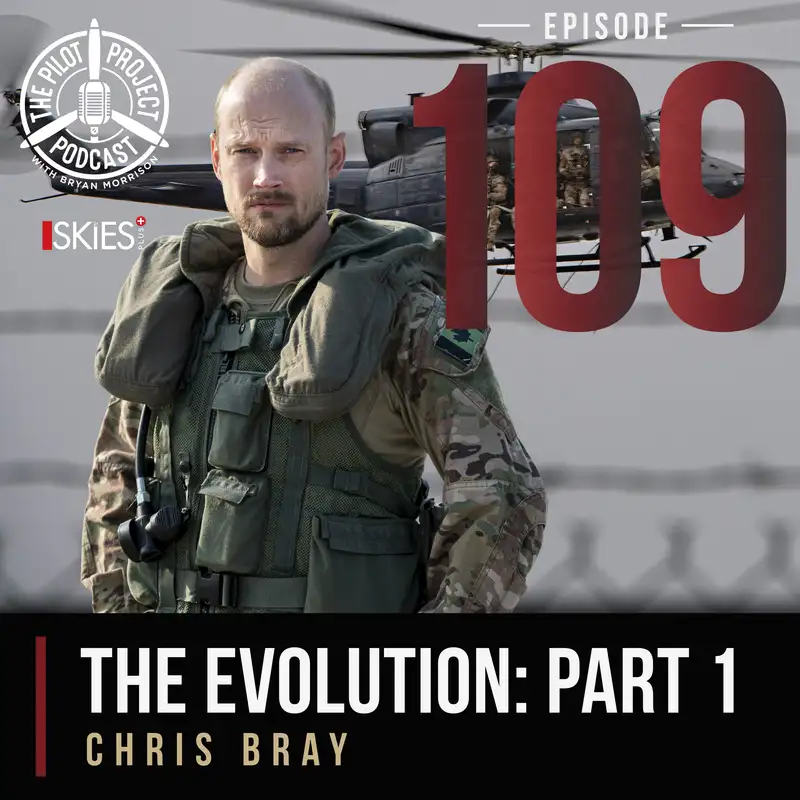
Special Ops: The Evolution Part 1: Becoming a 427 Squadron Special Operations Aviator – Chris Bray
This podcast is presented by Skies Magazine. If you're interested in the Canadian aviation industry, Skies is your go to multimedia resource for the latest news, in-depth features, stunning photography, and insightful video coverage. Whether you're an aviation professional or enthusiast, Sky's is dedicated to keeping you informed and bringing your passion for aviation to life. Visit skysmag.com to learn more and subscribe to stay updated on all things Canadian aviation.
Bryan:Alright. We're ready for departure here at the Pilot Project Podcast, the best source for stories and advice from RCAF and Mission Aviation Pilots brought to you by Sky's Magazine. I'm your host, Brian Morrison. And here with me today for an exciting discussion on special operations aviation in Canada is lieutenant colonel Chris Bray, commanding officer of four two seven special operations aviation squadron. Chris, I'm excited to have you here today, and thanks so much for being on the show.
Chris:Yeah, Brian. Really happy to be here and, yeah, we've been, looking to put this together for a while. So really happy that we could, finally get this going.
Bryan:Yeah. Me too. It was a journey, but I'm glad we, we put it together. So in this part of the conversation, we're going to focus on Chris's journey from growing up outside the military to becoming a special operations aviator and ultimately taking command of one of the most unique units in KansoffCom. But before we get to any of that, let's go through Chris's bio.
Bryan:Lieutenant colonel Chris Bray enrolled in the Canadian Armed Forces in 2005 as a pilot after completing a bachelor of science at Dalhousie University in Halifax, Nova Scotia. He began his career following basic training at Saint Jean Quebec with an initial posting to the Joint Rescue Coordination Center in Halifax where he served as an assistant air controller. After completing rotary wing training, he earned his wings in 2010 and was promoted to captain. Chris was then posted to four two seven special operations aviation squadron as a CH one forty six Griffin pilot, where he deployed on multiple domestic and international operations, including operation impact, exercise flintlock, and operation Nanook. In 2018, he was promoted to major and posted to one Canadian air division headquarters in Winnipeg as the staff officer for tactical aviation systems and was later promoted to lieutenant colonel as the senior staff officer for tactical aviation.
Bryan:He returned to four two seven in 2020 as a flight commander where he deployed again on operation impact as a special operations aviation detachment commander. In 2022, he was appointed as the squadron's deputy commanding officer while also completing the United States Marine Corps command and staff program in Quantico, Virginia. In 2023, he was posted to National Defense Headquarters in Ottawa working within chief force development as the foresight team lead, helping modernize the Canadian Armed Forces approach to force development and design. In the summer of two thousand twenty four, Chris took command of four two seven special operations aviation squadron in Petawawa, Ontario. Now just before we dive into the interview, let's go over some acronyms we'll be using.
Bryan:SOF is Special Operations Forces. SOA is Special Operations Aviation. SOAS is Special Operations Aviation Squadron. CANSOVCOM is Canadian Special Operations Forces Command and is basically the entire command organization for our special forces. So you mentioned you were the first in your family to join the military.
Bryan:What originally pulled you towards that path?
Chris:Yeah. So beyond my father being a bit of a historical war buff, there's no history of, service in my family. But I did have a lot of close friends who joined the forces either during high school, like going into the reserves, or right out of high school, you know, going into, to RMC. So I was able to watch them from a distance. And once I was finishing university, you know, I started to weigh those options.
Chris:And I really looked up to these friends. I still do today. But I looked at the path that they were on, and that was something that was really interesting to me from, like, a career perspective. So I considered the forces closely at that point.
Bryan:At that point, were you also interested in aviation, or was that something that sort of happened as you started looking at your options?
Chris:So aviation was always an interest, but I wouldn't say it was a passion, at that point. So it really developed over time in my twenties. I had the opportunity to take some private flying lessons to prepare for flight training, but I was really coming into it, you know, fairly cold. I did have some extended family through marriage that was in the forces, from the Aurora community. So So I was able to kind of ask some questions about kind of the lifestyle, the training, things like that to get, kind of a broad kind of preparation or insight to what the, career was like.
Chris:But it really developed over time that passion. So I'm currently, you know, twenty two years into the forces. So I'm extremely passionate by this point. But it certainly developed over time.
Bryan:What do you think sort of tweaked you into that direction? Like, what what started that off?
Chris:So, like I said, my dad was a bit of a a a war buff. And I do remember as a kid, you know, he would bring me out to the airport to see aircraft kinda taking off. So I was always interested in just the aviation aspect even as a kid being exposed to it. But, I think it was really you know, when I was in my early twenties, you know, Afghanistan was starting to really to heat up, And, it it was very apparent that there was some opportunities in the forces, to really kinda be a part of that. So in terms of, you know, looking at rotary wing, you know, I'm an eighties kid.
Chris:So I grew up with, like, Airwolf and Mash. So there is always something appealing to me about, delivering people to a fight, I guess. So flying a helicopter, has that additional, I would say, level of freedom, from flying, you know, as you can slow down, stop, land anywhere. And you can really get creative in terms of how you, approach aviation problems, and that was always appealing. So initially, though, when I started, pilot training, you know, I was the only one who wanted a rotary wing, which is not uncommon, you know, as we go through flight training.
Chris:But what I found was a lot of people started to gravitate towards rotary wing just because we were entering that height of Afghanistan and we've seen a lot of the great work that was happening overseas.
Bryan:Mhmm. Yeah. I was let me see. Yeah. In like, when September 11 happened, I was 15.
Bryan:And so, basically, as I was entering my late teens, like, that stuff was all heating up. And as I was starting to think about going into the military, that was on my mind too. And I definitely had some similar thought processes, like, you know, even to the extent of thinking about combat arms or I did my OJT and attack Hell Squadron. I think personally, as I've gotten older, I've learned that I probably wouldn't have been cut out for that world. We all have our our strengths and what we're suited to.
Bryan:But the other cool thing that you mentioned that I have definitely learned from doing this show and talking to so many helicopter pilots is the you talk about like the freedom of how you approach different problems. And it's just interesting to me the way like, in a fixed wing plane, you've you've got the prevailing winds, you've got the favorable runway, and that's where you're landing. And you're gonna do a circuit basically to get there or an IFR approach and that's that. The helicopter world, I'm sure that there are obviously fairly regimented approaches and things, but, you know, if there's an LZ, a landing zone that you guys need to get to, you know, you need to figure out a plan, you need to figure out the way to get in there and the obstacles and all those different things. Like, everything is unique and different, it seems.
Chris:Yeah. And, you know, kind of fast forwarding ahead here, that's exactly it. So that's a lot of the considerations that we have, you know, in soft aviation. But, you know, rotary wing in general is those considerations because you can't always control those obstacles, poles, wires, and sometimes you have to deal with the hand that you're given in terms of how you approach, a landing or an insert, but you gotta get that job done. So, you try to mitigate some of those variables, but it surely gives you, you know, more flexibility in terms of where you can land and go, but it also puts other variables into the equation that you have to consider as well and, risk manage.
Bryan:Mhmm. Yeah. And and it seems like those are common skills across the world of flying helicopters in the forces. Like, I talked to a lot of star pilots and they obviously have to stay really flexible in their thinking and planning and replanning as things change. Even if you're talking about maritime helo, just like, okay, sometimes you go back and like the ship's not where you thought it would be or, you know, the weather changes massively between you and the ship or where the ship is or or whatever.
Bryan:It just seems like that's kind of inherent to helicopter operations.
Chris:Yeah. And soft aviation is very similar, and we we're kind of a a hybrid of all those environments because we operate, you know, high, hot, heavy, domestically, you know, Arctic conditions and maritime as well. So specifically the pilots at four two seven. We have to understand all those operating environments because we're not just dedicated to, you
Bryan:know, to a single operating environment. Right. Because within 4Q seven, you would also be doing, like you said, maritime operations at times. So you would have to practice flying in conjunction with ships or doing, you know, putting a group of people on a ship or things like that. Right?
Chris:Yeah. Absolutely. And that's a a large part of our training. You know, operating in the maritime environment is, you know, the most risk we take in training. At this point, the platform we have, the Griffin, it served us really well over the last number of years, but, you know, it's not purpose built for the maritime environment.
Chris:So we have to rely heavily on the, the skill of our aircrew to buy down the risk in that environment.
Bryan:So let's talk about your first operational exposure, which was at JRCC Halifax. Your first posting was there at Halifax as an assistant air controller. Can you tell us what that role involved and how that experience shaped your understanding of operations?
Chris:Really, working at JRCC Halifax kind of exposes you to that kind of joint space because you're colocated with the Canadian, Coast Guard in the exact same kind of operations center. So you have the the two sides, the RCAF and the Coast Guard working together to, support lives. You know, you're tasking high readiness air assets and working with people, who take that role very seriously. The pace was extremely busy, and it was not uncommon to, be responding and managing, many simultaneous responses in a single shift. Most notably through the, you know, spring, summer, fall season, it can get quite busy.
Chris:But, you know, that that really taught me how to work under tense timelines, in high stakes operations that have, you know, strategic impacts or public significance, which, you know, when I kind of put all that together, it's not uncommon to where, you know, I operate within soft or we operate within soft. So, you know, working in a joint environment, tasking high readiness assets, and very motivated people to achieve strategic effects.
Bryan:Yeah. There there's definitely a significant overlap in the personality of people who excel in search and rescue and in special operations. Like, if you have ever met anyone who works with any of our special operations forces, like in terms of the, the ground folks and then you work with the Sartech, you'll realize that they're like a very, very similar breed. And I would imagine that that cross pollination continues in a lot of the different roles in those worlds.
Chris:Yeah. And that prepared me really well for, when I arrived at 04/27 in that integration into CanSoftcom. So those, you know, two years at JRCC Halifax during, you know, pilot training was really, really valuable. And it really demonstrated early on, you know, the value of, like, teamwork professionalism under extremely high stakes. Me personally, I work more, effectively under pressure, which certainly helped me, during flight training and my career overall.
Bryan:Yeah. And, speaking of flight training, you did phase one on The Grove here in Portage, phase two on the Harvard. How did those phases go for you?
Chris:Yeah. So they went quite well. Back then, there was, a little bit of a pilot backlog. But like I said, that's why I was fortunate that I had that, JRCC OJE to fall back on to, you know, keep things, interesting and, and meaningful, during the phases. But phase one on the grobe was relatively short, but I certainly remember the people that I had on course.
Chris:A great group of individuals. We really pulled each other through. And a lot of those individuals, I did the follow on courses within, Moose Jaw, the back and portage for phase three. And some of them I work with to this very day in KansoffCom, which is, is pretty neat.
Bryan:Yeah. That's pretty cool. What do you remember most about your rotary wing training leading up to getting your wings in 2010?
Chris:Yeah. So I would say the the challenge itself, I remember, like I mentioned, I didn't have a very strong aviation background coming into it. So just the fact that everything was new, that I was doing, I found I was able to, adapt to that and learn just by surrounding myself by, you know, the the talented people that I had on course that, you know, some of them had some aviation experience. So really surrounding yourself by those people that had an idea of what we need to do and how to get through it. So I found that really helped me out.
Chris:So I think the challenge itself was what I remember in that kind of first phase one, phase two. But, you know, I was not a naturally gifted pilot at first. So what I found what really pulled me through is those, relationships and kind of those late night study sessions, with people that, you know, anyone who went through, you know, the RCF pilot system knows how valuable those late night training sessions are with, with your peers. So, really, yeah, that's what, you know, kinda pulled me through.
Bryan:Yeah. I can definitely remember a lot of evening sessions in the common rooms in the Shacks and Moose Jaw before exams and stuff quizzing each other and making sure everybody's ready to go. And it's definitely we we've said this many times, but it's definitely a team sport getting through pilot training in the RCAF.
Chris:Yeah. And, you know, another challenge is the fact that you have very little time to get things right. You know, you're only one or two flights away from it being your last.
Bryan:Mhmm.
Chris:So I found, you know, the the challenge of the training itself, but also you also had very little time to, correct any deficiency and kind of overcome that. So, you know, that was a a challenge as well.
Bryan:And once you actually started flying helicopters, you know, what was that like to go from fixed wing to rotary wing?
Chris:So I would actually say phase three rotary wing, is where things started to click for me. So I did the system where you did the first basic handling on the, two zero six, but then you went on to the four twelve. I was on one of the very first courses that use that new hybrid model. Okay. I found that when I got onto the four twelve, though, I felt more connected to the aircraft.
Chris:And depending on the instructor that you had, I felt like there was more freedom to kind of play with the aircraft. It was less, you know, kind of demonstration and do and repeat. There was more time for you to do what you needed to do to become comfortable with the aircraft. Like, if you wanted to go work on, you know, more confined areas or you're more advanced handling, in the hover, there was more opportunity to do that. So I found after phase three or during phase three, that's when things really started to click because I could do some training kind of on my own terms Mhmm.
Chris:With the, you know, assistance of, you know, the the talented instructors that they had at the time.
Bryan:Yeah. And, it's funny. You're talking about confined areas there, and it sort of triggered this memory for me of when I was in OJT with four hundred squadron in Borden, when they were still a reserve operational squadron. And one of the first flights they did was to that I was on, sorry, was just a regular training flight. They were doing all kinds of different stuff and they went down into a confined area and I was like, holy cow.
Bryan:Like, you're telling me you guys go into a space that tight and fly that close to trees. Like, some of the stuff that a helicopter can do is is pretty crazy, and it must be pretty jarring the first couple times they get you to do that as a student.
Chris:Looking back now, you know, it's very common on the civilian side. But from a military perspective, we really rely on that crew concept to provide, you know, that situational awareness around the aircraft, making sure that you're, safe from any obstacle. But in Portage on phase three, it's you and an instructor flying the four twelve. So, you know, opening up your door on each side, looking behind you to see, you know, is the tail rotor safe? I do remember that being a little bit concerning, back then.
Chris:Then once we moved, into more of the crew concept with a flight engineer, you you really understand the value of having those eyes and ears, behind you.
Bryan:Yeah. Actually, it's funny you say that. I had I hadn't considered that because another core part of that memory is that the flight engineer the whole time was conning the pilots. I hadn't thought about how much crazier that would be without a flight engineer there to tell you how far you are from the trees and stuff. That must be pretty wild.
Chris:I found I would try to find the largest, confined area that they deemed suitable just to, you know, ensure that we're gonna be safe and effective. But, you know, after a while, they would challenge you, to more difficult confined areas that required a little more, you know, finesse in aircraft handling to get down there, safely.
Bryan:Yeah. And you said that phase three was kinda where things came together for you. Was there, like, a moment on that course where it really clicked?
Chris:Yeah. I think it was near the end of the clear hood phase. So that's when you finish kind of all those basic handling and VFR sequences because that's where you really got to be more hands on with the aircraft. After that, you move it on to the IFR phases. So that's more procedural based as you know.
Chris:But at the end of the clear hood, I felt like I had a good grasp on the machine. And then near the end of the course, you start to do the night flying and you get exposed to NVG operations, which adds that, you know, additional layer of difficulty, safety consideration, and challenge as well.
Bryan:So you finished phase three and you got selected for four two seven, which must have been a pretty big exciting thing for you at that point because you have to go through all kinds of extra screening and selection for that. Right?
Chris:So at the time, the screening process was not as mature as it is today.
Bryan:Okay.
Chris:So there was an informal interview that all the newlywing grads who would go to four two seven would conduct usually with the DCO of four two seven. Usually, it was just a a phone call to ensure that you knew what you were kind of walking into. So, you know, extreme high readiness, professionalism, things like that.
Bryan:Mhmm.
Chris:But it was a very quick interview. And I think, really, it was more of a confirmatory that the posting message was already, written back then. So quite a bit different than what we, we have today.
Bryan:Right. So, basically, at the time, making sure the person kinda knew what they were in for and that they really wanted what they'd what they'd signed up for kind of thing.
Chris:Yeah. Absolutely.
Bryan:How does that compare to today? Can you talk much about the the screening process for today?
Chris:So what's unique about four two seven, and we'll talk about this later on as well, is we screen absolutely everybody who comes to the unit. So there's a screening process, and everyone is volunteers as well. So nobody just gets posted to four two seven or KansoffCom in general. You have to submit your notice of intent, a short application process, which triggers the screening process itself, the career manager, and occupation side of things. So it's quite in-depth.
Chris:Usually involves interviews, a file review. We do a psychological evaluation as well just to make sure that you're ready for employment in cansoftcom. So a lot of those things we didn't have in place back then at four two seven specifically, but we do have now. And it really speaks to the quality of people that we have at four two seven and in cansoftcom right now. We get great members from across the CAF, whether you're a pilot, maintainer, logistics, signals.
Chris:That screening process really ensures that we're getting people who are ready for employment in CANSOFTCOM. At four twenty seven, and I think generally across the RCAF, we talk about the crew concept, but we take that very seriously at four two seven. We don't really differentiate, you know, pilots from flight engineers. We're we're air crew. We work as a cohesive team.
Bryan:Mhmm.
Chris:But, yeah, absolutely everybody gets screened the the exact same way. But pilots specifically, we do, an air crew file review as well. Go through your training history because it gives us insight in terms of your trainability.
Bryan:Yeah. And just sort of like if they have a learning personality that's suited to what they're about to go through, like that kind of thing.
Chris:Yeah. Just to make sure that we have a pretty good sense if you can stay on the learning curve, that they're about to embark on.
Bryan:Mhmm.
Chris:Because you can have the the best attributes that we're absolutely looking for, but ultimately, you have to be trainable, as well. And it's a fairly steep training curve.
Bryan:For sure. So you arrived at 427 as a brand new pilot. What were your first impressions of the unit?
Chris:Yeah. So extremely operational. You could feel that the bar was set, extremely high. And as a new pilot, you feel that the road ahead of you is going to be long because it wasn't just all the tactical aviation kind of sequences you had to do at the time. There was the additional layer of all the SOA sequences, which historically takes longer to get through all that.
Chris:Even between back then and today, it's similar timelines. You know, it takes about eight years to get you fully qualified on all the kind of sequences and capabilities that we have at four two seven. So your typical first year, can be anywhere from six to eight years. And that's simply just to get you to the point where, you know, you're an aircraft commander able to do the full spectrum of a capability. But going to my impressions back then, you could feel that that path, was gonna be long and challenging, and you definitely had to be ready to learn.
Chris:When I arrived, we're kind of at that height of rotary wing aviation in Afghanistan. So the unit was extremely busy, where a lot of people were on high readiness to, you know, go on their rotation. And then another half of the unit, which was on high readiness to, support domestic operations.
Bryan:Wow. That must have been, like, a a really crazy time for the people at the squadron.
Chris:Yeah. And, you know, at first, you're trying to figure out where do you fit into all this. But, you know, first step was getting on to your OTU, engage town, get qualified on the Griffin. And then it it was it's only really after that that you get, assigned to the subunit that you're gonna work with for the next, number of years.
Bryan:And let's get into some of that unit organization. This was before the 2011 restructuring that four two seven underwent. Can you tell us what the squadron looked like at that time and how it's different from the modern structure?
Chris:So the divide between domestic and out of area operations, was pretty clear at the unit at the time. Both sides being extremely passionate and dedicated to their missions, but very separate and siloed within their subunits. So we had a, b, and c flight at the time, where a flight primarily supported Edivari operations. B flight supported, domestic operations, and c flight was really the holding pattern or the feeder, subunit into those two subunits, a and b flight. So, historically, you entered the unit into c flight.
Chris:You went on your OTU. You get qualified. And then once you were a graduate of the OTU, then you got put into either a or b flight at the time.
Bryan:What was it like to start out in b flight at that point in your career?
Chris:Yeah. So b flight provided a dedicated support to CanSoftcom for domestic operations, which stemmed from supporting the RCMP back in the eighties, and early nineties. So B Flight had the majority of the unit experience, in terms of aircrew with, many of the aircrew having, you know, many thousands of hours doing a very specific and unique set of skills. And, a flight was supporting operations most notably over in Afghanistan. So very different set of missions, roles, and tasks at the time.
Chris:So very siloed, like I mentioned, where you kinda had a one half of the unit doing one thing and another half doing the other. And there was very little cross pollination, which is, night and day different to what we have today, which is, subunits that virtually are trained to the same standard, have the same capabilities, and are really able to go out and do the exact same job. So very different than what we have, today.
Bryan:It sounds like the new structure is a little more flexible. Probably gives you a little more ability to trade people if you need to and and just sort of have that flexibility for who gets tasked on what.
Chris:Yeah. And it really came out of a necessity as well, like rewinding a bit. You know, when I arrived at the unit, KansoffComm as a whole was pretty new. So having, you know, one subunit, supporting a very specific mandate and then another subunit supporting at a very operations, that's not really sustainable. Specifically, if you start considering sustained operations and multiple rotations and deployments
Bryan:Mhmm.
Chris:That's not sustainable or, you know, equitable or fair to have the same group of people on a high readiness rotation like that. Yeah. So, it was really out of necessity that the unit had to evolve so that we had a bigger pool of people able to support, you know, the newly formed, cansoffcom. And it wasn't just supporting, you know, one unit within the command. You know, there's there's other units that we had to start considering as well when we start considering, seesaw and CGIRU.
Chris:So the soft aviation enterprise had to start growing, to support the multiple users of aviation within the new command.
Bryan:Can you just quickly explain to the listeners what CSOR and CGIRO are?
Chris:Yep. So, CSOR is the Canadian Special Operations Regiment, which, focuses on special warfare. And CGIROO is our CBRN unit that focuses on, that capability.
Bryan:And just for the listeners, because, of course, our acronyms have acronyms within them, CBRN stands for chemical, biological, radiological, and nuclear. So get into some of your early operations. You've deployed on operations like OpImpact against ISIS in Iraq, exercise flintlock in Africa, and Opninook in Canada's Arctic. What were those early operational experiences like for you?
Chris:Yeah. So coming from a a domestic operations background, this kind of felt like starting over
Bryan:Mhmm.
Chris:In many regards for me. It's different skill sets, capabilities, considerations. So it took a little bit of swallowing my own pride to learn something new by that point. Because by that point, I was inexperienced aircraft commander. I've been at the unit for close to six years by that point.
Chris:So, you know, I really have to thank, the TUSOA guys. So, you know, the previous a flight with all their experience for kind of holding my hand through that. I deployed with them for the majority of my first kind of out of area operations. So those early deployments allowed us to really develop, you know, our force projection SOPs and TTPs that were critical to our, agility and rapid deployable capability that we have today. But for me specifically, it felt a little bit starting over and learning a new skill set.
Chris:You know, for domestic operations, it's a very different threat or level of considerations that, you would have to consider in your, mission planning.
Bryan:For sure. In this case, when you're talking about kind of when your learning curve was steep, are you able to tell us what theater you were operating in at the time?
Chris:So Opninook obviously operating, in Canada's Arctic. So at that time, we were really showcasing some of CansoftCom's capabilities that we had in the, mid twenty tens. On exercise flintlock, we're part of an exercise in Africa that was really focused on, partnership development, training those, partners. But, really, that was valuable for us to start looking at how do we employ soft aviation in that environment. So it was really mutually beneficial.
Chris:So while we were there to to work with a partner and develop capability and capacity, it was beneficial to us to start developing our own capabilities to force project in a rapid fashion and operate as leanly as possible.
Bryan:Okay. Are you able to talk at all about your work in OpImpact?
Chris:So, OpImpact, we're operating in, Iraq and supporting KansoffCom, which fit under, a larger special operations task force, that was over there, which was multinational. So that was a great experience over there, bringing that soft aviation capability within that theater.
Bryan:What was it like to fly in an area like Iraq where the threat environment was a little more present?
Chris:Yeah. So it really evolved over time. So we were there for several years and the considerations that we had at the beginning were not the same ones that we had once the theater was, more mature.
Bryan:Mhmm.
Chris:But, you know, we never took that for granted. Every flight that we did, we always considered, you know, what's possible out there.
Bryan:Mhmm.
Chris:And we would ensure that we're mitigating that effectively. So, you know, that theater really matured, over the years. And like I said, what we are considering to be a risk at the beginning was not the same thing as it was in the end. The environment as well. So, in Northern Iraq, the the temperature swings can be quite, drastic compared to the South.
Chris:So you can go from, you know, extremely hot. But when you're flying at altitude, it can get quite cold. So going through those extremes in terms of, temperature fluctuation was a risk in itself.
Bryan:Without getting too into specifics, what makes soft aviation missions different from conventional flying?
Chris:Yeah. So I'll speak, kinda broadly about what makes soft aviation missions different, before we get into the flying more specifically? Sure. Because a lot of our unique capabilities depend on the support we receive from our, enablers. So first off, like, we have persistent and extreme high readiness.
Chris:So we're able to go out the door extremely quickly. The size of a detachment, is quite different than on the conventional size as well. We're extremely lean. We only deploy with exactly what we need to do the mission. And, you know, one that allows us to remain agile, but also, kinda speaks to the quality of people that we have within cans of comm as well to enable the operation.
Chris:So speaking about the maintainers, logistics, signalers, those enablers are absolutely critical to our operations, but the size of the detachments are extremely small. We also plan for every plausible, contingency as well. And in many cases, we develop, training to mitigate in certain cases as well. So we really walk the dog on a lot of what could happen. And we walk through that, put mitigations in place so that, we can buy down that risk.
Chris:But we really pay attention to, the detail of every mission. From a flying perspective, we certainly have unique capabilities at four two seven and, certain skill sets. But I think most importantly, we really fly the Griffin to its limits, but not beyond. We have to get creative with that platform that we have, to keep it relevant and employ it in the vast different operating environments we might find ourselves in as well. But also, there's a lot of inherent risk in everything that we do, within cansoftcom as everything has potential strategic consequences.
Chris:So we have to really pay attention to our readiness, capabilities, culture. Those things always have to be on point, and ready to go.
Bryan:Mhmm. The RCAF holds itself to a very high standard. And within aviation, it's a life and death industry, so there's always an extremely high standard. But it sounds like even more so within the special operations world that there's a very, very extreme level of professionalism and readiness.
Chris:And there's multiple reasons for that. Like, oftentimes, we operate with very little external support, and we have to approach things often from either a cansoftcom or a Team Canada approach. So you may not have all the, you know, theater level assets that, you know, a conventional deployment may have access to. So we really do have to pay attention to those contingencies, really consider all the what ifs and mitigate those.
Bryan:Mhmm.
Chris:But we have absolutely amazing people, highly skilled and trained, that really do get creative in how we can employ the platform we have to still deliver, you know, soft aviation effects even though it's a challenging environment.
Bryan:Mhmm. And as you mentioned, like, the Griffin does have its limits. And probably our listeners are familiar with the fact that we're in the middle of what they call NTAK's next tactical aviation capability set, which is the search for the replacement for the Griffin, which I believe will be multiple platforms because the Griffin is kind of enforced into a bit of a Swiss army knife role. You guys must be excited for that, I would imagine.
Chris:Yeah. So CAN Softcom and four two seven is gonna be a beneficiary of that. And like you mentioned, it's a capability set. So it's designed to replace the Griffin, broadly with a set of fleets. So not just one single workhorse.
Chris:So we're really excited for what that's gonna deliver. We, as in four two seven and KENS OFFCOM, have been prioritized for the first phase of NTACS. So we're gonna see that fleet change kind of first when we look at the implementation of NTax as a whole. So we're really looking forward to that and, you know, seeing an increase to our capability in terms of range payload, which really enables us to provide options to CanceOfCom and the government of Canada options that we didn't have before. So really looking forward to that.
Bryan:Yeah. And I don't wanna go too far down this rabbit hole, but I think it's gonna be really interesting to see. You know, they're talking about potentially attack helicopters. They're talking about various forms of transport. I think it's gonna provide so much flexibility and it's gonna be really, really interesting to see the organizational changes and just the way, like, four two seven is gonna completely transform in terms of what it does and how it does it.
Chris:Yeah. And we are, you know, by this point, we're a really mature organization within soft aviation. The only missing piece to that puzzle is, you know, the platform to really bring us to that next level.
Bryan:Mhmm.
Chris:So that we we are able to deliver the full spectrum of rotary wing capability like our partners and allies. We put a lot of focus on the culture at four two seven, in professionalizing soft aviation, which we'll, talk about later on. We're at the point now where we're only held back by the platform that we have. We are a world class organization. We are on par with, a lot of our partners and allies who have very kind of mature soft aviation entities.
Chris:So, yeah, getting a platform change for us is something we're really looking forward to.
Bryan:I think it'll be a very transformational moment in the history of four two seven in the same way that Afghanistan was. So we talked about kind of what makes soft aviation different. We said we were gonna talk a bit about what makes the missions themselves different. So, like, how does a soft aviation mission differ from a conventional aviation mission?
Chris:You know, it kinda starts off with that hide readiness. So just the fact that we can get out the door on a short notice is kind of that first step. Having a very small detachment as well. We like to get out the door as lean as possible to conduct our, missions. And I think we already talked about some of those other elements as well in terms of planning for any of those contingencies, and really talking about those plausible scenarios and mitigating as required.
Chris:We also deliver, unique capabilities that, only four two seven delivers in terms of specialized insert extract profiles Okay. In flying that aircraft, really to its limits. And then like we already touched on the operating environment as well, which has very high stakes to it and strategic consequences.
Bryan:Okay. So something that would be more along the lines of something that we get tasked to four two seven would be something that requires, like, very fast response, agility, like you said, has high stakes, potentially, let's say, political or strategic consequences, like that kind of thing.
Chris:Yeah. So when we when we start looking from, like, a homeland defense perspective, getting into crisis response. So when we look at a crisis, within Canada, whether it be a significant event, nationally, like a hostage rescue situation, that's where we could be employed to, bring those skill sets to the table. And we work together with our other, federal departments to bring that capability together.
Bryan:Okay. Right on. Let's get into a bit of your roles and responsibilities in four two seven. You've done a ton of different jobs in four two seven over the years. Can you tell us about kinda how your role evolved from a new pilot to basically where you're at now?
Chris:So after getting qualified as a first officer, they started to layer on different duties, you know, at the subunit level. So that's a a normal progression once you became qualified at the unit. So you could start to get employed, within subunit ops, and then they start layering on, you know, potentially secondary duties as well. So you may have a position within the subunit where you're, supporting, you know, ops and planning, and then you could have, like, a unit level secondary duty as well. So as time kind of progresses, you start to get more responsibilities, layered on to your, you know, primary job of being a pilot.
Bryan:Eventually, you started taking on more leadership roles, more supervisory roles. At what point did you find that you were transitioning from focusing on, like, your own performance and development as a SOA pilot? Because like you said, that takes, like, six to eight years to kind of become a master of the trade to being responsible for leading others.
Chris:I held definitely, quite a few positions at the unit in parallel to being kind of a a line pilot. So I held almost, every position we had within subunit ops in terms of being a scheduler, deputy ops, ops, and then eventually moving up to squadron operations where I held several positions there as well. And then once my time progressed at the unit, I filled roles such as deputy flight commander or OC, DCO eventually, and now where I am as a as a CO.
Bryan:And as you moved up, like, when did the big shift come, do you think, where you started to focus on not just your own training? Like, I guess that kind of organically happens as you start taking on all those different roles and gaining, like, a bigger picture perspective.
Chris:So I think the first time this really hit is when I became a subunit, operations officer. And within 04/27, the subunit OPSO is really running the subunit in terms of the daily activities, planning, and executing the training evolutions where the OC or the flight commander is managing, you know, the risk and, ensuring that we're operating within the authorities. So that was kind of the biggest evolution was, becoming a subunit operations officer because all our training evolution, our deployments on the exercises or operations heavily revolves around that position.
Bryan:Yeah. Working in ops, it's not like the most exciting thing. And it's often a job where if everything's going right, people are too busy to notice and if everything's going wrong, people are at your desk screaming. I found that working in ops was some of the most challenging years I spent in the air force. But it also really gives you a perspective for everything that's going on within the unit and like how everything has to come together And there's so many intricacies that are all performing things at the same time to make things come together.
Chris:Yeah. And because we're such a a small organization and a flat organization within CanSoftcom, At the unit level, there's certain planning factors and considerations that we have to do at the unit level. So a lot of coordination with, say, law enforcement or local government, entities to put training together.
Bryan:Mhmm.
Chris:So, you know, being a subunit, opso at the time, you know, I was able to really get out there, meet different, agencies and partners to, you know, put together our training evolution. And that was really important in terms of my development to, you know, get those relationships built and work with other governments, municipal, and law enforcement, agencies.
Bryan:Yeah. There's definitely, like, almost a maturing process that happens as you work in, like, joint or combined ops, which for listeners, joint would be other elements within your own force, like Navy, Air Force, Army, and then combined other countries or other government agencies. As you start interacting and kind of being a representative of your unit or your element or your country, you're kind of put on this stage where you have to be a a very professional ambassador to your unit or your country or your element or whatever the the case may be.
Chris:Absolutely. And, you know, this speaks to our responsibility of being, you know, a good custodian of the organization as well. So, you know, when we go out there and we interact with our government and law enforcement partners, or other militaries as well, You're representing CanceOffCom as a whole, not just four two seven.
Bryan:Mhmm.
Chris:So we have to make sure that, we're being good custodians of the organization, being, accurate, being good integrators of other capability as well to kind of deliver that strategic effect.
Bryan:Mhmm. And I will say that people in CanSoftcom seem to be just masters of that skill. I've had interactions with, you know, obviously can't get too specific, but had interactions with different people within the CanSoftcom world. And it's like, working with them is like a shot of adrenaline. You know, if you're starting to get tired, if you're starting to lose motivation and then you step into a briefing with people from that world, it's like, boom.
Bryan:Like, there's nowhere else you wanna be.
Chris:Yeah. We have great individuals, highly motivated. And like I said, you know, they're all screened and selected for the job. So that's a real benefit within KansoffCom is you're working with many like minded people who are extremely motivated to, you know, have mission success. So really fortunate to work with a lot of people like that, like you mentioned.
Chris:And, you know, you'll have good days and bad days or days where, you know, your energy is, not at its highest, but you're surrounded by people to keep you motivated. And that's really what I love about this organization is the the teamwork, aspect of it.
Bryan:Now you were a so a flight lead. Can you briefly explain what that is and how that shaped how you think about accountability and decision making?
Chris:A flight lead is a aircraft commander, who has the appointment of being a flight lead. And really what that means is is that you are responsible for the safe planning and execution, of the mission. So you really have to have really sound, decision making abilities, being able to adapt, with how the mission is, kind of evolving and executing and kinda make decisions on the fly. So the flight lead is ultimately responsible for the execution of the rotary wing component of a mission that would be a part of a larger package. Usually, it's a part of a a multiship formation of aircraft, and they're executing their portion of that mission.
Bryan:Okay. Did you find that taking on that role changed your thoughts on accountability or how you made decisions?
Chris:Yeah. So as a flight lead, that's where you really start to feel the gravity, of the position because you're responsible for that safe execution of the mission. And, you know, you're responsible for making sound decisions in line with, the mission and your commander's intent. And what taught me in terms of how to be a better leader was that experience as a flight lead. So now I I ensure that the flight leads, they have the context, the direction and guidance, to execute the mission because they need that level of autonomy.
Chris:You you can never guarantee that you'll always have comms with that element, you know, once they depart. So they have to have the direction and guidance and the leeway to execute a mission and make decisions as the mission unfolds. Because you may not have all the best and relevant information, you know, back in, let's say, in in the headquarters or the talk, and the most relevant information may be downrange. So the flight lead has to have that responsibility to make sound decisions while, say, the detachment commander or the CO in the rear maintains ultimate kind of accountability.
Bryan:So it sounds like a lot of weight on your shoulders in that position.
Chris:Yeah. Because like I said, it's, your responsibility is to execute the mission as briefed and to execute any of the contingencies that were considered in that mission planning. And usually what triggers reach back is when, there's a situation that you didn't foresee happening. And that's where usually the flight lead will reach back either to the air mission commander or the AMC, who may also be in the air, but in a different location in the battle space, or reaching back to the detachment commander who's usually back in the talk.
Bryan:You came back from that ground tour to 04/27 as a flight commander and deployed on op impact as a detachment commander. How different was that experience compared to your early deployments when you were basically a pilot?
Chris:So being a detachment commander, the gravity of the position hits you because you no longer have the safety net of the unit of four two seven because you now fall under a different chain of command structure. So you are the authority and expert on soft aviation for that operation and that new chain of command.
Bryan:Mhmm.
Chris:So you're expected to provide, you know, factual and credible expertise in manage risk and work within the authorities. So being a detachment commander is an extremely important position in your development as an officer within four two seven in CanSofcom. Because it's the the first time where you are given the full kind of spectrum of supporting an operation from a detachment perspective, managing the people, finances, authorities that you have to support the mission.
Bryan:In this case, you're in OpImpact. You're operating in Iraq. As we said before, there is a threat environment. Did you find it was different to fly in a threat environment yourself versus tasking people to do those missions?
Chris:That's an interesting question because like I said, I grew up in a domestic context. So my first deployment experience, at a area that was different from a flying perspective for me is to consider a threat that could pose, you know, a threat to the aircraft at any point.
Bryan:Mhmm.
Chris:Where domestically, you know, you have a certain level of, permissiveness to get to where you're going.
Bryan:Mhmm.
Chris:So you don't have the same considerations. So, you know, flying the aircraft in a manner that protects you and everyone on board to those potential threats on route is different than to what I had to do, before.
Bryan:Yeah. So definitely a shift in mindset.
Chris:Absolutely.
Bryan:Yeah. At one point, you were working in force development and foresight. Can you just quickly explain sort of what that is and what you learned about where the CAF is heading doing that job?
Chris:Definitely heading in a, in an amazing direction, and that is that our force development is, you know, now threat informed and concept driven. And what that means in practical terms is that as we force develop or conceive capabilities, we acknowledge the fact that the enemy gets a vote and that the operating environment drives some elements of how we should develop capabilities in CAF and how we're structured. So working in force development, specifically in the, foresight directorate was really interesting because we looked at, you know, the operating environment many years into the future of what it could look like to ensure that, as we develop new capabilities now in the CAF that it considers those insights that we are developing.
Bryan:It sounds really interesting. And I really like that you talked about acknowledging that the enemy gets a vote. I feel like there are many cases in history for sure where that's just simply not done. And it as you obviously know working within special operations where flexibility is paramount. Like you said, you have to be able to adapt to the environment.
Bryan:You have to be able to accept the fact that the enemy is going to react to what you do and change your plans and and all that kind of thing.
Chris:Yeah. And that's been a pivotal change within, CAF is modernizing our approach to, forest development and design. And it's really exciting stuff that they're doing right now. And I'm confident that, you know, we're getting the capabilities that we're going to need now and, you know, ten, fifteen, twenty years in the future.
Bryan:That's awesome. And I'm I'm really excited to talk about that in in part two. You ended up doing a staff tour at one CAD or one Canadian Air Division as the senior staff officer tactical aviation. Obviously, that was a big shift from being at the squadron. What do you think was the biggest thing you learned about the bigger picture of tactical aviation?
Chris:Yeah. So going to one cat for me, it was a complete one eighty. And it's truly about becoming, an enabler and an adviser to the one CAD senior leadership. But you really get out of it what you put into it. We moved some massive files when I was there from, 2018 to 2020 to better enable tack aviation and soft aviation.
Chris:So that was a great opportunity. But what I learned about tack aviation was really the scale of tack aviation took some adjustment because, you know, they have multiple units, spanning the entire country
Bryan:Mhmm.
Chris:Conducting, you know, different activities. So coming from 04/27 at the time, I I didn't have a full appreciation of, how one wing or tac aviation truly operated, until I had this experience.
Bryan:Well, you guys are in a bit of a silo at 427 within TAC Aviation. Right?
Chris:Correct. So at the time, we were still a part of TAC Aviation. So we still had some residual responsibilities back to the air force.
Bryan:Mhmm.
Chris:But they flowed through one wing tactical aviation. But we very much operated on our own supporting CAN Softcom, and we only really went through One Wing or back to the RCAF if we triggered some of these residual responsibilities, such as, you know, flight safety, airworthiness, any of those things where we would require support from One
Bryan:Wing. Mhmm. Okay, Chris. That is gonna wrap up this part of our chat today. I really enjoyed hearing about how you got into this line of work, hearing about your experiences within special operations aviation, and sort of getting into broad strokes how four two seven operates.
Bryan:In the next episode, I'm really excited to dive into an in-depth look at how special operations aviation has evolved in Canada and what makes four two seven unique. So, again, thank you so much for your time today. I really enjoyed it.
Chris:Yeah. Thanks, Ryan. Looking forward to, part two.
Bryan:Awesome. Fly safe. Alright. That wraps up part one of our discussion on special operations aviation with lieutenant colonel Chris Bray, CEO of four two seven Special Operations Aviation Squadron. Join us again next week as we sit back down with Chris to hear about the story of how four two seven became the unit it is today, some new capabilities they're bringing online, who four two seven actually is, and what sets them apart from other special operations aviation units around the world.
Bryan:Do have you any questions or comments about anything you've heard in this show? Would you or somebody you know make a great guest, or do you have a great idea for a show? You can reach out to us at the pilotprojectpodcast@Gmail.com or on all social media at pod pilot project. And be sure to check out that social media for lots of great videos of our RCAF and Mission Aviation aircraft. As always, we'd like to thank you for tuning in and ask for your help with the big three.
Bryan:That's like and follow us on social media, share with your friends, and follow and rate us five stars wherever you get your podcasts. That's all for now. Thanks for listening. Keep the blue side up. See you.
Bryan:Engineer, shut down all four. Shutting down all four engines.